
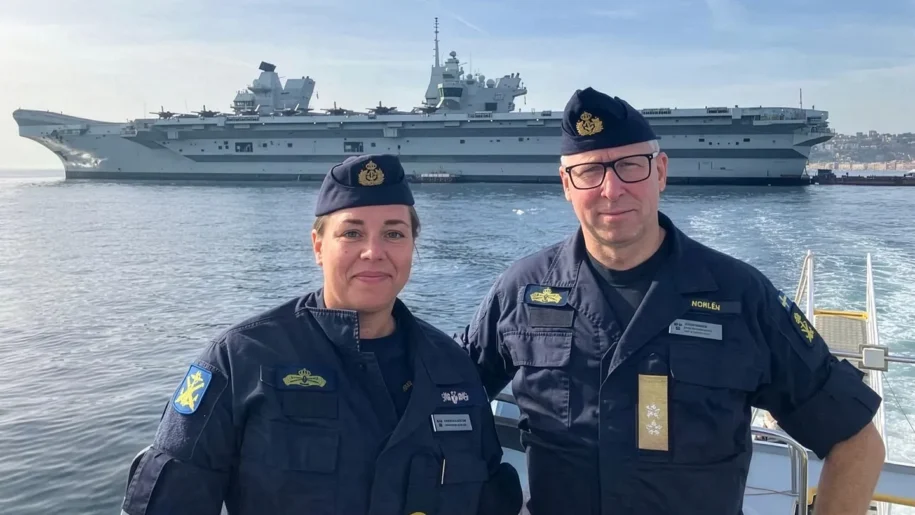
Av Kapten Marianne Hamilton Ekholm.
Författaren tjänstgör för närvarande som utvecklingsofficer vid Sjöstridsskolan. Artikeln skrevs som en del av masterprogrammet MSc in Technology (Maritime Operations) vid Kingston University i London. Den ursprungliga versionen av artikeln publicerades i The Naval Review. Artikeln publicerades av Kungl. Örlogsmannasällskapet i Tidskrift i Sjöväsendet, nr 2, 2026.
Bild tillsammans med marinchefen från författarens tid som Sveriges första elev vid Royal Navy´s Principal Warfare Officer Course. (Foto: Försvarsmakten).
Introduction
Sweden’s accession to NATO has already reshaped long-standing assumptions about its defence posture. While early analysis has understandably focused on the Baltic Sea, Sweden’s geography, capabilities and political alignment point towards a broader responsibility, particularly in supporting NATO maritime forces in the North Atlantic.1 Integration, however, is not merely a question of membership, but of whether Sweden is prepared to meet the operational, cultural and institutional demands of effective alliance participation.
This article explores how a navy historically shaped by coastal defence and sea denial can adapt to alliance operations beyond its immediate waters. The central question is not whether Sweden can integrate into NATO, but what it must change in order to do so credibly in the open Atlantic.
Geography, logistics and the Arctic gateway
Sweden’s strategic geography has always shaped its naval posture. Historically, this has meant a focus on the Baltic Sea, a confined, shallow and politically sensitive maritime environment where national control and rapid response have been crucial. With NATO membership and the renewed emphasis on transatlantic reinforcement, that geography now assumes a broader meaning. Sweden’s west coast, particularly Gothenburg and the maritime approaches through the Kattegat and Skagerrak, is emerging as a critical node within NATO’s northern maritime architecture.2
As Russia continues to assert its military presence in the Arctic and the wider North Atlantic, and as allied attention shifts towards securing northern sea lines of communication, Sweden’s role as a logistical and operational enabler is expanding. Although Sweden does not have direct access to the North Atlantic or the Arctic Ocean, its location and infrastructure create natural corridors linking the Atlantic, Scandinavia and the Baltic region. These corridors are central to future reinforcement and sustainment efforts in northern Europe.3
Gothenburg,3 Sweden’s largest port, plays an important role in this context. Beyond its significance as a commercial hub, it represents a staging and sustainment point for NATO maritime operations. From Gothenburg, naval units transit through the Skagerrak into the North Sea and onward into the wider Atlantic theatre. In a crisis, the port could function as a logistical bridge between continental Europe and Norway, supporting allied forces operating in the High North. Swedish defence authorities have explicitly identified the west coast, including Gothenburg, as a key element in revised defence planning associated with NATO membership.4
Further north, while the Gulf of Bothnia is not likely to serve as a primary operating area for high-end surface combatants such as the future Luleå-class frigates, it retains broader operational relevance. Locations such as Luleå and Boden provide strategic depth in terms of logistics, command-and-control resilience and host-nation support. These areas are considered within NATO planning as potential rear-area hubs, connected via overland routes to Norway and Finland and capable of supporting sustainment, intelligence and resilience across the Arctic–North Atlantic axis.5
Equally important, Sweden’s growing participation in operations and exercises beyond the Baltic Sea is contributing to the development of practical habits of integration. Deployments such as Operation Highmast, which included Swedish personnel, demonstrate not only political commitment but also the Navy’s ability to adapt to unfamiliar environments, extended timelines and multinational command arrangements. Such experiences are key to preparing for real-world operations beyond traditional national waters.6
As Arctic sea routes become more accessible due to climate change, allied interest in the region continues to grow. Although not an Arctic coastal state, Sweden is a northern state whose surveillance capabilities, infrastructure and proximity to close NATO partners make it a relevant contributor to future maritime awareness and deterrence efforts. Sweden’s contribution is likely to focus less on forward naval presence and more on enabling functions such as logistics, air defence coverage, communications support and situational awareness along key reinforcement corridors.7
In this evolving context, geography is not destiny but a strategic opportunity. Sweden’s ability to provide secure ports, staging infrastructure and reliable access routes positions it as a natural enabler of NATO’s northern posture. Realising this potential, however, will require sustained investment not only in platforms and personnel but also in infrastructure and planning coherence. Ensuring that ports like Gothenburg, and key areas in northern Sweden, are fully integrated into NATO logistics frameworks and operational planning will be essential.
Sweden’s integration as a maritime actor within NATO extends beyond the fleet itself, including ports, logistics corridors, command centres and the procedures that enable sustained naval presence. To-gether, these sea- and shore-based elements underpin Sweden’s long-term credibility as a contributor to NATO’s northern strategy.
NATO’s northern flank – strategic trends
The GIUK Gap has long occupied a central place in NATO’s maritime planning. Positioned between Greenland, Iceland and the United Kingdom, it constitutes a critical maritime corridor linking the North Atlantic to Europe. During the Cold War, the area was essential for tracking Soviet submarines and securing transatlantic reinforcement routes. Today, its strategic relevance has once again increased, as Russia’s renewed military activity in the Arctic and the wider North Atlantic has refocused attention on the protection of sea lines of communication linking North America to Europe.8
Since 2014, and particularly following Russia’s full-scale invasion of Ukraine in 2022, NATO has undergone a marked shift in posture. The alliance has moved from a model centred on symbolic presence and tripwire deterrence towards one focused on credible warfighting readiness, forward planning and rapid reinforcement. This evolution is most visible in the North Atlantic and the High North, where the ability to secure transatlantic reinforcement routes has re-emerged as a core requirement for allied defence.9
This renewed focus is reflected in NATO’s command structure. Joint Force Command Norfolk reached full operational capability in 2021 as NATO’s first operational headquarters on American soil since the Cold War. Its mandate is to protect the Atlantic and Arctic maritime approaches and to ensure the integrity of transatlantic reinforcement. In December 2025, Sweden, Finland and Denmark were formally transferred to JFC Norfolk’s area of responsibility. This placed Sweden directly within NATO’s primary planning framework for transatlantic maritime operations and crisis response.10
Within NATO thinking, the North Atlantic and the Arctic are in-creasingly treated as a single, interconnected operational environment. Climate change is extending the operational season in the High North, while Russia’s military infrastructure and naval activity along its northern coastline (particularly around the Kola Peninsula) continue to shape allied deterrence and access to the Atlantic. These developments reinforce NATO’s assessment of the Arctic–North Atlantic axis as a unified strategic theatre requiring persistent surveillance, resilience and multinational coordination.11
Although Sweden does not operate in the open Atlantic, its position between the Baltic Sea and the North Atlantic places it close to key allied areas of operation and makes it a contributor to the security of NATO’s northern flank. Maritime movement between the Baltic and the wider Atlantic passes through areas adjacent to Swedish territory, and Sweden’s ability to support surveillance, logistics and intelligence-sharing across this space is valued within alliance planning.
NATO membership also entails expectations regarding host-nation support and integration into reinforcement flows. In scenarios involving the defence of Norway or Finland, or the protection of reinforcement routes through northern Europe, Sweden’s role as a supporting and enabling actor becomes particularly significant. This places new demands on interoperability, situational awareness and the ability to operate within NATO command-and- control structures at both the operational and tactical levels.
Taken together, these developments illustrate a fundamental shift in NATO’s northern posture. The defence of the North Atlantic is no longer the exclusive responsibility of a small number of traditional maritime powers. Instead, it increasingly depends on contributions from a broader group of allied nations whose geography, capabilities and infrastructure enable collective resilience. The question is no longer whether Sweden is part of the alliance’s northern flank, but how effectively it can contribute to its defence.
Sweden’s future surface capabilities
For decades, Sweden’s surface fleet has been optimised for operations in the confined and often contested waters of the Baltic Sea. Emphasising coastal defence, fast attack capabilities and signature reduction, platforms such as the Visby-class corvettes reflect a highly specialised approach to littoral warfare. Designed for sea denial rather than sustained presence, these vessels have proven effective in their intended environment, offering stealth, manoeuvrability and credible surface strike capability. Recent upgrades, including the integration of short-range air defence missiles, have enhanced self-protection and enabled limited escort functions. Nevertheless, the Visby-class remains constrained by endurance, command infrastructure and the absence of layered air defence systems required for prolonged operations as part of a multinational task group.12
The shift in Sweden’s strategic environment has prompted a reassessment of this maritime posture. Rather than focusing on operations close to national waters, future requirements emphasise the ability to support allied missions across wider theatres. This transition is embodied in the development of the future Luleå-class frigates: a new generation of surface combatants intended to enable Sweden to operate credibly within NATO maritime structures.13
Although the final design has not yet been selected, [artikeln skrevs före beslutet om att köpa franska fregatter, webmasters anm.] Sweden is expected to procure an existing NATO-standard platform, potentially based on a British, French or Spanish design. Reporting suggests that this procurement reflects not only operational requirements but also broader industrial and geopolitical considerations, with a decision anticipated in the near future. Regardless of the final platform choice, the underlying intent is clear: to field surface combatants capable of sustained operations, integrated air defence and full interoperability within allied task groups.14
The move from corvette-based sea denial to frigate-based sea control represents more than a change in platform size. It signals a conceptual evolution in how Sweden intends to contribute to collective maritime security. In practical terms, this presents a strategic choice: whether to employ these new frigates as nationally optimised assets with limited alliance integration, or to operate them as fully integrated components of NATO task groups, shaped by alliance doctrine, readiness standards and operational tempo. The latter implies a cultural transition from independent operations in confined waters towards sustained participation in multinational formations across the wider Atlantic theatre.
Operating within NATO task groups, in less familiar environments such as the North Atlantic, places different demands on naval forces than those typically encountered in the Baltic Sea. Such missions require not only capable platforms, but also robust endurance, full-spectrum interoperability and the ability to contribute to a shared maritime picture in real time. The value of a surface combatant in this context is defined less by its individual capabilities than by its ability to integrate seamlessly into a multinational task group.15
To meet these demands, Sweden’s future frigates will require credible air defence capability, sustained endurance and high-capacity communications. Systems such as Link 16 and Link 22, integrated sensors and combat management systems, and NATO-compatible command structures are essential enablers. Yet technology alone is insufficient. The challenge will be to ensure that Swedish crews are as proficient in multinational procedures, terminology and decision-making as in operating the platforms themselves.
Observations from allied training environments further reinforce this pattern. One of the most striking differences between Swedish and NATO command structures is that the latter are characterised by a deeply embedded culture of scenario-based planning, tactical foresight, and the systematic use of table-top exercises. Within NATO, these are not optional tools but habitual practices, applied consistently across domains of warfare and at all levels of command. This exposure demon-strates how planning discipline and anticipatory thinking are cultivated well in advance of a unit entering a formal readiness evaluation process. Flag Officer Sea Training (FOST) should be understood in this context. Rather than serving as a training pipeline, FOST functions as a demanding assessment mechanism designed to test whether such behaviours are genuinely internalised at unit level. Swedish Visby-class corvettes have previously undergone FOST, an experience that proved strongly norm-setting for those units. Since then, however, Swedish surface combatants have not returned to FOST, despite continued recognition of its value.
An illustrative example can be found in NATO navies that routinely employ Flag Officer Sea Training (FOST) following major maintenance periods and prior to deployment. It serves to validate planning assumptions, expose weaknesses and confirm readiness against a shared operational standard. These navies similarly use FOST as an external benchmark. For Sweden, this suggests a clear parallel with officer education abroad: just as allied training institutions are used to develop individual competence, allied readiness and evaluation frameworks such as FOST could be employed more systematically to assess and strengthen unit-level preparedness for NATO operations. Used in this way, FOST becomes not an end in itself, but a practical tool for measuring how well Swedish units are prepared to operate within multinational task groups at sustained tempo.16
In this context, distributed synthetic training (DST) offers a complementary mechanism for preparing units and crews for integration into NATO maritime operations. Such training is already widely used within NATO navies to rehearse procedures, decision-making and command relationships in simulated environments prior to live exercises and formal readiness assessments.17
The Swedish Navy is not unfamiliar with synthetic training. Simulator-based instruction in navigation and warfare, as well as tactical gaming within the Swedish Defence University, already plays a role in officer education and early professional development. The distinction lies less in the availability of such tools than in how and when they are employed. Within many NATO navies, distributed synthetic training is increasingly used later in the readiness cycle, closely linked to forthcoming operations, exercises or external evaluations.
Used in this way, DST supports the development of shared operational understanding, procedural fluency and familiarity with alliance tempo. This allows ships and staffs to enter live multinational training and assessment environments, such as FOST, with greater readiness and confidence. Importantly, DST should be understood not as a substitute for live training, but as a means of strengthening its effectiveness. For a navy adapting to sustained participation in allied task groups, this approach can reduce friction and support a more confident transition into NATO operational frameworks.
Traditionally, Swedish naval doctrine has emphasised platform-centric solutions optimised for national defence. Ships were designed as largely self-contained units, each tailored to specific roles such as surveillance, anti-surface warfare or mine countermeasures. While the Visby-class introduced greater multi-role flexibility, it remained rooted in a platform-focused concept rather than a fully networked system-of-systems approach.
Future operations within NATO task groups, however, demand a different logic. Contemporary maritime warfare is increasingly defined by system-level integration, where sensors, effectors and decision-makers are linked across platforms and domains. Sweden’s next genera-tion frigates will therefore need to function not merely as individual warships, but as nodes within a wider allied command-and-control architecture. This represents a shift in operational responsibility, from national tasking towards real-time integration within NATO decision loops and command structures.18
Redefining capability in this context means moving beyond coun-ting hulls or missile cells. What matters is the ability to contribute to a shared operational picture, exchange targeting data and engage threats in coordination with allied units. Achieving this requires full interoperability: technical, procedural and conceptual.
The Luleå-class frigates thus represent a decisive step in Sweden’s ability to contribute meaningfully to NATO maritime operations. More than a technological upgrade, they embody a shift towards networked, interoperable surface combatants designed for high-threat environments and multinational task group operations. Within the emerging regional naval ecosystem, Sweden is expected to complement allied capabilities through contributions to air defence and tactical integration. Realising this potential, however, will depend not only on procurement decisions, but on institutional adaptation and a willingness to align training, readiness and command culture with alliance standards.
Command integration and multinational operations
Sweden’s naval command culture has traditionally emphasised national control. Planning, decision-making and execution have largely taken place within national frameworks, shaped by territorial defence priorities and the operational conditions of the Baltic Sea. Even during multinational exercises, Swedish units have often retained a high degree of operational autonomy, sometimes by necessity due to limited interoperability or restricted access to alliance command-and-control systems. That context is now changing.19
NATO membership does not invalidate Sweden’s established command tradition, but it fundamentally alters the environment in which it must operate. While national command will remain relevant in certain scenarios, future maritime deployments beyond the Baltic will increasingly be conducted within alliance command structures.20 This shift affects more than reporting lines. It reshapes how Swedish commanders plan, lead and contribute within combined operations.
Sweden is not entering this environment unprepared. Long-standing engagement with NATO doctrine, participation in NATO’s Partnership for Peace, and regular involvement in multinational exercises have established a solid foundation. Full membership, however, introduces a fundamentally different level of integration. Swedish officers must now operate within NATO’s full operational tempo and planning cycles, rather than alongside them.
Within alliance-led task groups, strategic objectives are defined collectively, tasking is distributed across nations, and command relationships are managed through multinational planning staffs. Swedish officers must therefore be prepared not only to execute assigned tasks, but to actively shape operational design. This includes articulating national capabilities, contributing to planning processes and accepting delegated responsibilities from non-national command authorities.21
Such roles demand confidence, doctrinal fluency and the ability to operate comfortably within integrated hierarchies rather than nationally bounded command structures.
This represents an adjustment to Sweden’s traditional leadership model. Rather than operating independently or coordinating laterally, Swedish commanders will increasingly function within vertically integrated alliance command arrangements, where national and collective objectives must be balanced under compressed timelines and dynamic operational conditions. The challenge here is not one of competence, but of adaptation to a different command environment.
Effective integration therefore depends on deep familiarity with NATO’s command-and-control architecture. This extends beyond technical interoperability to shared assumptions about decision-making authority, planning cycles and acceptable risk. Swedish officers are educated within a tradition of “uppdragstaktik”, which places strong emphasis on understanding higher commander’s intent and exercising initiative at the lowest appropriate level. In this respect, Swedish command philosophy aligns closely with NATO’s concept of mission command in principle.22
However, operational fluency is determined less by doctrinal alignment on paper than by how doctrine is applied in practice under pressure. In NATO maritime operations, particularly in areas such as air defence and integrated maritime operations, command is often characterised by centralised planning combined with decentralised execution. This places high demands on procedural discipline, shared situational awareness and the ability to operate effectively within formalised planning and control processes.
Participation in Standing Naval Forces has provided valuable exposure to alliance operations, but Swedish involvement has so far been limited in duration and scope.23 Building sustained credibility will require deeper and more continuous engagement, including operational roles within NATO formations rather than participation primarily through exercises. Advanced NATO-aligned warfare officer programmes, including PWO and AWO training, play a key role in preparing officers for this environment. These programmes are not academic in nature, but immersive, reflecting the tempo, complexity and decision-making demands of contemporary alliance warfare.
Command integration also extends to the political–military interface. As Sweden assumes more active roles in NATO-led operations, questions regarding command authority, national caveats and delegated responsibility will become increasingly prominent. Balancing effective operational contribution with retained political control con-stitutes a strategic challenge rather than a purely procedural one.
Ultimately, Sweden’s effectiveness within NATO maritime operations will depend less on formal command appointments than on functional integration.24 Credibility is built through the ability to plan, decide and act within alliance command structures under the same tempo and expectations as long-standing members. Command integration is therefore not an end state, but a continuous process. To build trust and influence, Sweden must actively seek leadership roles within NATO formations and ensure sustained exposure to multinational planning and command environments.
Training, command culture and operational mindset
Sweden’s integration into NATO maritime operations is not determined solely by platforms and technical systems. It is equally a question of people, command philosophy and training. Regardless of platform capability, the ability to command, coordinate and sustain operations within a multinational force ultimately depends on human factors.25
This reality is already shaping how the Swedish Navy approaches personnel development. The introduction of new capabilities, such as the Sea Ceptor air defence system and the forthcoming Luleå-class frigates, has exposed limitations in existing educational and organisational models. Traditionally, training has focused on anti-surface and anti-submarine warfare within a predominantly Baltic context. NATO integration, however, requires a broader competence profile, including air warfare, cross-domain coordination and familiarity with alliance procedures.26
For much of the post–Cold War period, Swedish surface combatants lacked air defence capabilities beyond basic self-protection. The integration of Sea Ceptor on the Visby-class, and the planned air defence role of the Luleå-class, therefore represent a significant shift. This development places new demands on tactical-level leadership, particularly for officers responsible for planning and executing air warfare within a task group. National training is being adapted accordingly, and a limited number of officers now attend advanced NATO-aligned courses abroad. These initiatives are essential for building the technical fluency and command confidence required in high-end maritime operations.27
Technical adaptation alone, however, is insufficient. Cultural change is equally important. Historically, Swedish naval units have operated under national command and within geographically constrained environments. As a NATO member, Sweden’s forces will increasingly be commanded from multinational headquarters and operate within alliance planning and decision-making cycles. Operations in areas such as the North Atlantic will involve longer deployments, integrated planning processes and sustained multinational tasking. This requires not only doctrinal familiarity, but practical confidence in NATO procedures, terminology and operational tempo.
Increased integration into NATO maritime operations will also shape how Swedish officers and crews experience training and readiness. Closer alignment with alliance standards is likely to involve higher operational tempo, more frequent external evaluation and sustained exposure to multinational command structures. For personnel who have primarily operated within national frameworks, this represents a shift in rhythm and expectations rather than a fundamental change in professional identity.
Initial adjustment is therefore most likely to concern workload, tempo and familiarity with alliance processes, rather than willingness or competence. Over time, repeated participation in multinational training, exercises and deployments is likely to normalise these conditions and embed them into everyday practice. The central challenge is not adaptation as such, but ensuring organisational continuity and personnel support that allow experience to build across crews and key warfare roles. Experiences from allied operations and training environments suggest that the real value of such exposure lies not in individual techniques, but in the habits they create. Repeated exposure to high-tempo planning environments shapes how officers internalise uncertainty, manage complexity and exercise judgement under pressure.
Endurance presents a further challenge. While much attention is often paid to platform endurance, sustained multinational operations place equally demanding requirements on crews. The Swedish Navy maintains a continuous presence in the Baltic Sea, typically through relatively short deployments supported by national infrastructure. Extended operations in more distant theatres introduce different conditions: longer periods at sea, reduced access to home support structures and sustained multinational tasking. These factors require new approaches to crew rotation, onboard living standards and mental resilience. This places increased emphasis on personnel management and long-term manpower planning. Sustained operations in the North Atlantic will depend not only on technical readiness, but on policies that ensure continuity in key warfare roles, predictable rotation patterns and effective welfare support. Observations from Operation High-mast, particularly in cooperation with the Royal Navy and the Royal Norwegian Navy, suggest that such personnel structures are critical enablers of operational effectiveness over time.
Ultimately, Sweden’s credibility within NATO maritime operations will not be measured solely by the number of platforms delivered or sensors integrated. It will depend on how well Swedish naval personnel are trained, supported and culturally integrated into alliance operations. Tactical competence, sustained readiness and the confidence to operate within multinational command structures will determine whether Sweden is perceived as a reliable contributor or a constrained participant. This transformation must begin well before the first Lu-leå-class frigate enters service, not after it.
Conclusion – from observer to contributor
Sweden’s accession to NATO marks a strategic shift not only in geography, but in mindset. For decades, Swedish maritime strategy was shaped by Baltic proximity, national command and coastal denial. These concepts are no longer sufficient. The evolving security environment across the High North, the GIUK Gap and the wider Atlantic demands more than territorial focus. It requires presence, readiness and integration at the heart of alliance operations.
That transformation is already underway. The planned Luleå-class frigates, increased engagement in Arctic exercises and Sweden’s growing participation within NATO structures all point to a navy preparing for a broader mission. Yet platforms alone will not define Sweden’s credibility. Contribution in NATO is not measured by tonnage or technology, but by the ability to act effectively, collaboratively and consistently within multinational frameworks.
This is not a question of competence. Sweden’s officers and sailors are well trained and highly professional. The challenge lies in adaptation: to new command relationships, extended deployments, wider operational theatres and a different culture of planning and execution. The experience of allied navies offers valuable reference points—not for blind replication, but for deliberate and purposeful adaptation.
Integration does not occur automatically. It must be rehearsed, supported and lived. Tactical proficiency must be matched by cultural fluency, and national experience must evolve into multinational relevance. Whether serving under non-national command or assuming leadership roles within allied formations, Swedish naval personnel must be prepared not only to fit in, but to lead when required.
Sweden will not become a strategic maritime actor in NATO by default. It must choose to become one through investment in people, trust in partners and a willingness to shift perspective from the defence of territory to the defence of the alliance. The capability exists. What remains is the intent to realise it. Above all, Sweden must train as it intends to fight: within NATO, not merely alongside it. This is not simply a shift in posture, but a sustained shift in mindset, one that must be trained, rehearsed and reinforced over time. Sweden’s naval future will be forged not at home, but where the alliance needs it most.
* * *
- Försvarsmakten, Så förändras försvarsplaneringen av Natomedlemskapet (2024). In this article, the term “North Atlantic” refers to the maritime space west and northwest of the Baltic Sea, including the Skagerrak, North Sea and Norwegian Sea.
- International Institute for Strategic Studies (IISS), The GIUK Gap’s Strategic Significance, Strategic Comments (London, 2019); SPECTIO, The Danish Straits: A Strategic Maritime Gateway at the Heart of European Security.
- The Arctic Institute, Russia’s Arctic Military Posture in the Context of the War Against Ukraine (2024); L. Odgaard, Closing Arctic Gaps: How NATO Allies and Partners Can Protect Their Homelands (2023).
- Försvarsmakten, Så förändras försvarsplaneringen av Natomedlemskapet (2024).
- Totalförsvarets forskningsinstitut (FOI), Natomedlemskapets konsekvenser på sjödomänen, FOI Memo 8446 (2024).
- Government Offices of Sweden, Sverige deltar i Operation Highmast i Indopacifiska regionen (2025).
- Odgaard, Closing Arctic Gaps; The Arctic Institute, Russia’s Arctic Military Posture.
- International Institute for Strategic Studies, The GIUK Gap’s Strategic Significance (2019).
- NATO, Strategic Concept (Madrid, 2022), pp. 5–6.
- NATO, ‘Joint Force Command Norfolk Declares Full Operational Capability’ (2021); Försvarsmakten, Nytt NATO-högkvarter för Sverige, Finland och Danmark (2025).
- FOI, Natomedlemskapets konsekvenser på sjödomänen (2024).
- Saab Group, Visby-class Corvette; Försvarsmakten, Luftvärnsrobot på Visbykorvetterna (2023); FOI, Natomedlemskapets konsekvenser på sjödomänen (2024).
- FOI, Natomedlemskapets konsekvenser på sjödomänen (2024); Försvarets materielverk (FMV), Nya ytstridsfartyg – större och med mer kapacitet (2023).
- SVT Nyheter, Spelet bakom Sveriges miljardköp av nya fregatter – storpolitik.
- Center for Maritime Strategy, The Swedish Navy Brings Capable Forces to NATO (2024).
- Navy Lookout, Prepared for the Fight – Royal Navy Operational Sea Training (6 July 2023); E. Shamir, Transforming Command (2011), pp. 196–200.
- NATO Allied Command Transformation, Allies cooperate on next-generation training capability (2025).
- Ministry of Defence (UK), Allied Joint Publication AJP-3: Allied Joint Doctrine for the Conduct of Operations, Edition D, Version 1 (2025).
- FOI, Natomedlemskapets konsekvenser på sjödomänen (2024).
- Ministry of Defence (UK), AJP-3: Allied Joint Doctrine for the Conduct of Operations, Edition D, Version 1 (2025), paras 1.1–1.2, 1.36–1.39, 1.45–1.46, 1.52–1.55.
- Ministry of Defence (UK), Allied Joint Publication AJP-5: Allied Joint Doctrine for Operational-Level Planning (2021), paras 1.1–1.2.
- Shamir, Transforming Command, pp. 3–5.
- Center for Maritime Strategy, The Swedish Navy Brings Capable Forces to NATO (2024).
- NATO Allied Command Transformation, ‘Swedish Full Military Integration Achieved’ (2025).
- FOI, Natomedlemskapets konsekvenser på sjödomänen (2024).
- Försvarsmakten, Luftvärnsrobot på Visbykorvetterna (2023); FOI, Natomedlemskapets konsekvenser på sjödomänen (2024).
- Försvarsmakten, Internationella uppdrag – en del av marinens nya vardag (2026), https://www.forsvarsmakten.se/sv/aktuellt/2026/01/internationella-uppdrag-en-del-av-marinens-nya-vardag/ [accessed 26 January 2026]; Försvarsmakten, Nytt NATO-högkvarter för Sverige, Finland och Danmark (2025).
- Ministry of Defence (UK), Allied Joint Publication AJP-3: Allied Joint Doctrine for the Conduct of Operations, Edition D, Version 1 (2025).
References
Center for Maritime Strategy. The Swedish Navy Brings Capable Forces to NATO. 2024. https://centerformaritimestrategy.org/publications/the-swedish-navy-brings-
capable-forces-to-nato/ [accessed 20 January 2026].
Försvarsmakten. Luftvärnsrobot på Visbykorvetterna. 2023. https://www.forsvars-makten.se/sv/aktuellt/2023/11/luftvarnsrobot-pa-visbykorvetterna [accessed 22 January 2026].
Försvarsmakten. Nytt NATO-högkvarter för Sverige, Finland och Danmark. 2025. https://www.forsvarsmakten.se/sv/aktuellt/2025/12/nytt-nato-hogkvarter-for-sve-rige-finland-och-danmark/ [accessed 27 January 2026]. Author’s translation from Swedish.
Försvarsmakten. Så förändras försvarsplaneringen av Natomedlemskapet. 2024. https://www.forsvarsmakten.se/sv/aktuellt/2024/03/sa-forandras-forsvarsplane-ringen-av-natomedlemskapet/ [accessed 21 January 2026]. Author’s translation from Swedish.
Försvarsmakten. Internationella uppdrag – en del av marinens nya vardag. 2026. https://www.forsvarsmakten.se/sv/aktuellt/2026/01/internationella-upp-
drag-en-del-av-marinens-nya-vardag/ [accessed 22 January 2026].
Försvarets materielverk (FMV). Nya ytstridsfartyg – större och med mer kapacitet. 2023. https://www.fmv.se/aktuellt–press/aktuella-handelser/nya-ytstridsfartyg–
storre-och-med-mer-kapacitet/ [accessed 22 January 2026].
Government Offices of Sweden. Sverige deltar i Operation Highmast i Indopacifiska regionen. 12 April 2025. https://www.regeringen.se/pressmeddelanden/2025/04/ sverige-deltar-i-operation-highmast-i-indopacifiska-regionen/ [accessed 27 January 2026].
International Institute for Strategic Studies. The GIUK Gap’s Strategic Significan-ce. Strategic Comments. 2019. https://www.iiss.org/publications/strategic-com-ments/2019/the-giuk-gaps-strategic-significance/ [accessed 21 January 2026].
Ministry of Defence (UK). Allied Joint Publication AJP-3: Allied Joint Doctrine for the Conduct of Operations. Edit D, Version 1. August 2025. https://assets.publish-ing.service.gov.uk/media/6964e72799fbdc498faecce2/AJP_3_Ed_D_V1-O.pdf [accessed 23 January 2026].
Ministry of Defence (UK). Allied Joint Publication AJP-5: Allied Joint Doctrine for Operational-Level Planning. March 2021. https://assets.publishing.service.gov. uk/media/6054d017e90e0724be025a8f/20210310AJP_5_with_UK_elem_final_ web.pdf [accessed 23 January 2026].
NATO Allied Command Transformation, Allies cooperate on next-generation training capability, NATO, 15 October 2025, https://www.nato.int/en/news-and-events/articles/news/2025/10/15/nato-allies-cooperate-on-next-generationtrai-ning-capability?/ [accessed 2 February 2026].
NATO. Strategic Concept. 2022. https://www.nato.int/content/dam/ nato/webready/documents/publications-and-reports/strategic-con-cepts/2022/290622-strategic-concept.pdf [accessed 22 January 2026].
NATO. Joint Force Command Norfolk Declares Full Operational Capability. 2021. https://shape.nato.int/news-archive/2021/joint-force-command-norfolk-decla-res-full-operational-capability [accessed 21 January 2026].
NATO Allied Command Transformation. Swedish Full Military Integration Achieved. 2025. https://www.act.nato.int/article/swedish-full-military-integra-
tion-achieved/ [accessed 27 January 2026].
Navy Lookout. Prepared for the Fight – Royal Navy Operational Sea Training. 6 July 2023. https://www.navylookout.com/prepared-for-the-fight-royal-navy-opera-
tional-sea-training/ [accessed 22 January 2026].
Odgaard, Liselotte. Closing Arctic Gaps: How NATO Allies and Partners Can Pro-tect Their Homelands. Hudson Institute, 2023.
https://www.hudson.org/national-security-defense/closing-arctic-gapnato-al-lies-partners-can-protect-their-homelands-liselotte-odgaard [accessed 27 January 2026].
Saab Group. Visby-class Corvette (product page). 2024. https://www.saab.com/pro-ducts/visby-class-corvette [accessed 22 January 2026].
Shamir, Eitan. Transforming Command: The Pursuit of Mission Command in the U.S., British, and Israeli Armies. Stanford, CA: Stanford University Press, 2011.
SPECTIO. The Danish Straits: A Strategic Maritime Gateway at the Heart of Euro-pean Security. 2023. https://www.spectio.fr/en/the-danish-straits-a-strategic-maritime-gateway-at-the-heart-of-european-security [accessed 18 January 2026].
SVT Nyheter. Spelet bakom Sveriges miljardköp av nya fregatter – storpolitik i mari-nens kölvatten. 15 November 2023. https://www.svt.se/nyheter/inrikes/spelet-bak-
om-sveriges-miljardkop-av-nya-fregatter [accessed 22 January 2026].
The Arctic Institute. Russia’s Arctic Military Posture in the Context of the War Against Ukraine. 2024. https://www.thearcticinstitute.org/russias-arctic-military-postu-
re-context-war-against-ukraine/ [accessed 27 January 2026].
Totalförsvarets forskningsinstitut (FOI). Natomedlemskapets konsekvenser på sjö-domänen. FOI Memo 8446. 2024. https://www.foi.se/rest-api/report/FOI%20
Memo%208446 [accessed 27 January 2026].
[…] Örlogskapten Hamilton har skrivit om Sveriges nya marina roll i KÖMS tidskrift och publicerades också i somras: Beyond the Baltic – Sweden’s emerging role in the North Atlantic […]