Sverige behöver en marin med global räckvidd


Av kommendör Marko Petkovic


Ladda ned här:  Särtryck ur TiS 485-496 2025, Sverige behöver en marin med global räckvidd.


En sammanhängande värld

Bland de avslutande orden i En svensk marin i Nato ställs frågan: Är vår uppgift i Nato att ”run the Baltic” eller är det försvaret av ”the global commons” som ska vara marinens huvuduppgift?[1] Med andra ord uttryckt: Hur bör morgondagens marin förstås i ljuset av att Europa och Asien geopolitiskt hänger ihop och hur bör detta påverka den svenska marinens utveckling? Sveriges säkerhet hänger inte bara på Gotland och Östersjön utan formas också i Röda havet, Hormuzsundet, Sydkinesiska sjön men framförallt i förståelsen av våra egna och allierades behov och prioriteringar. Därför måste vår marin byggas större och med global förmåga.

Under våren 2024 blev Sverige fullvärdig medlem i Nato, med ett uttalat löfte om att bidra till alliansens gemensamma säkerhet. Under samma period inleddes Europeiska unionens (EU) Operation Aspides jämte den USA-ledda Operation Prosperity Guardian, som ett svar på Huthimilisens alltmer frekventa attacker mot sjöfarten i Röda havet. Marinen har sedan starten bidragit till Operation Aspides med enstaka officerare och i skrivande stund med en officer till den av Storbritannien ledda hangarfartygsstridsgruppen under namnet Operation Highmast. Den sistnämnda syftar till att öka Natos beredskap och interoperabilitet samt främja rätten till fri sjöfart. Genom hamnbesök ska den visa på den globala handelns betydelse samt utgöra en plattform för diplomati. Försvarsmakten har också inlett samarbeten med Sydkorea, Australien och Japan om cyberförsvar och undervattensteknologi. På så sätt förstärks vårt partnerskap långt bortom det egna närområdet.

Parallellt med detta har den svenska sjöfartsnäringen på eget initiativ tagit fram en långsiktig strategi för att stärka näringen. I linje med detta har rederiet Stena Bulk AB registrerat det första av fem Suezmaxfartyg under svensk flagg. Först ut var Stena Sunrise som i slutet av juli flaggades om i Singapore. Infrastrukturminister Andreas Carlson kommenterade detta som att:

“Nu skrivs svensk sjöfartshistoria. […] Detta är ett mycket välkommet och positivt besked för svensk sjöfart, svensk konkurrenskraft och svensk beredskap.”[2]

Detta är inte symbolpolitik utan en strategi som utgår från att vår framtida säkerhet påverkas av utvecklingen i övriga delar av världen, inte minst Asien. Av den anledningen bör även vår marina förmåga reflektera detta. Men här haltar plötsligt verkligheten efter viljan.

Varför en marin?

Man kan ställa sig frågan varför en nation har en marin. Ken Booth hävdade redan under 1970-talet att en nation kan vilja nyttja havet för i huvudsak tre skäl. För det första i avsikt att transportera gods och passagerare. För det andra i syfte att transportera militära styrkor för diplomatiska ändamål eller för att slå mot mål till sjöss eller på land. För det tredje i avsikt att exploatera naturresurser i eller under havet.

En marin existerar därför som medel för att uppnå dessa målsättningar. Booth argumenterade för tre grundläggande funktioner i form av en treenighet och betecknade dessa som den militära, den diplomatiska och den polisiära funktionen. Marinen kan naturligtvis ha andra mer underordnade uppgifter utöver dessa grundläggande funktioner. Helt naturligt kommer också olika nationer fästa olika vikt vid respektive funktion i syfte att omsätta den egna politiken i faktisk handling.[3]

Fig. 1 Marina funktioner, Ken Booth

Utan att förlora sig i att beskriva de senaste decenniernas försvarsbeslut kan det konstateras att redan år 1958 påbörjades en omvandling av den dåvarande kustflottan, framförallt genom att fartygstyperna kryssare och jagare successivt utmönstrades. Som en konsekvens begränsades flottan därmed till det kustnära och regionala, en utveckling som fortsatte med oförminskad intensitet ända fram till år 2005. Då genomförde marinen en utbildningsexpedition med HMS Carlskrona vilken i någon mening gjorde anspråk på något annat än den militära funktionen i Booths treenighet. Det kan förstås som att politikerna genom försvarsberedningarna avgränsat bort de diplomatiska och polisiära delarna till förmån för den militära delen, det vill säga det direkta försvaret av territoriet. Att den polisiära delen avgränsats bort kan säkert motiveras av det historiska arvet från händelserna i Ådalen 1931, det vill säga att de militära resurserna ska begränsas till försvaret mot militära hot. De polisiära uppgifterna har därför fallit på sjöpolisen och en fristående kustbevakning. Här återfinns säkert också andra skäl i mer modern tid som den relativa graden av utvecklade nationer i vårt närområde och avsaknaden av synlig gränsöverskridande, kriminalitet eller sjöröveri. Att även välja bort den diplomatiska funktionen framstår emellertid som obegripligt, då likaväl som nu. Möjligen kan detta bero på en generell oförståelse för hur praktisk diplomati kan ta sig uttryck på global nivå eller för att det helt enkelt inte finns en tradition för detta i svensk utrikespolitik.

I och med globaliseringen har emellertid logistikkedjorna blivit allt längre och lagerhållningen reducerats genom så kallade just in time-transporter. Samtidigt som detta lett till billiga varor har varuförsörjningen därigenom blivit sårbar. Det finns i dagsläget inte möjlighet att likt statsminister Per Albin Hansson vid andra världskrigets utbrott tala om att vår beredskap är god.[4] I dagsläget är den enda marinen som på egen hand har kapacitet att operera globalt den amerikanska, men den amerikanska utrikes- och säkerhetspolitiken kan som bekant numera förändras med mycket kort varsel. Vi står därför inför ett vägval där vi antingen kan ta ett uttalat ansvar för skyddet av sjöfarten tillsammans med andra europeiska nationer eller söka minska vårt beroende av logistikkedjorna genom att öka den inhemska produktionen inom fler områden än förnybar energi och batteritillverkning. Det sistnämnda framstår dock som svårt att åstadkomma ekonomiskt, åtminstone på kort sikt.

Sveriges utrikespolitik kräver maritim räckvidd

Sveriges utrikesminister Maria Malmer Stenergard påpekade i 2025 års utrikesdeklaration att Asien och Oceanien är de regioner i vilka den största ekonomiska tillväxten förväntas ske och att Asien och Europa därmed blivit allt mer sammanlänkade med varandra i säkerhetspolitiskt avseende. Kinas alltmer aggressiva agerande i regionen med hot om militärt våld mot Taiwan var enligt utrikesministern emellertid ägnat att inge oro, vilket i sin tur riskerade att påverka framtidstron på ekonomin. Kinas indirekta stöd till Rysslands krig i Ukraina hade också haft en direkt negativ effekt på Sveriges och Europas säkerhet.[5] Sverige måste därför enligt utrikesministern vara en global partner för säkerhet med särskilt fokus på den fria sjöfarten och det regelbaserade internationella systemet. Den indopacifiska regionen har därmed blivit ett nyckelområde för svensk och europeisk närvaro i syfte att åstadkomma ett ömsesidigt förstärkande säkerhetsutbyte med allierade och partners.

Regeringens ambition att stärka närvaron i den indopacifiska regionen måste omsättas i en operativ strategi i vilken en stark marin förmåga spelar en central roll. I juli 2024 fastställde regeringen den försvarspolitiska inriktning i vilken regeringens ambition att utveckla sitt försvarspolitiska engagemang och försvarssamarbete med partnerländer i den indopacifiska regionen beskrevs. De försvarspolitiska relationerna tar sin utgångspunkt i bilaterala politiska, militära och kommersiella ömsesidiga intressen. Dessa intressen utgör en viktig utgångspunkt, liksom frågan om under vilka förutsättningar ett utökat samarbete kan ske. Tre fokusområden för det praktiska arbetet med att implementera strategin utpekas i skrivelsen – försvarspolitiska relationer, militär närvaro samt försvarsmateriel-, innovations- och tekniksamarbete.[6]

Både EU och Nato har flera plattformar som Sverige relativt enkelt skulle kunna bygga ytterligare närvaro på i regionen. Det skulle ge marinen förutsättningar att delta i fler och större aktiviteter än dagens utplaceringar av enstaka förbindelse- eller stabsofficerare i olika kapacitet. Inom EU återfinns Coordinated Maritime Presence North Western Indian Ocean, (CMP NWIO) det vill säga koncept för samordnad närvaro till havs i nordvästra Indiska oceanen under vars paraply EU:s medlemsländer kan odla diplomatiska kontakter bi- eller multilateralt och samtidigt stödja ett säkerhetsinriktat kapacitetsbyggande med partnerländer i hela regionen. Nato har inga försvarsåtaganden i regionen, men har pekat på kopplingen mellan försvarsrelaterade utmaningar i den euroatlantiska och den indopacifiska regionen. Utmaningar i försvarsdomäner som inte är geografiskt bundna, som cyber, rymd, hybrida påverkansoperationer och ekonomisk säkerhet är redan eller kan komma att utvecklas till hot. Nato lägger därför särskild vikt vid att stärka banden med Japan, Sydkorea, Australien och Nya Zeeland.[7]

Natos uppdaterade i slutet av juli 2025 sin maritima strategi som inleds med orden: [8]

“The world is inextricably connected by its oceans and seas. They are essential to ensure global commerce and our way of life…security is no longer regional.”

Strategin tydliggör att Ryssland och terrorism är det omedelbara hoten men betonar att den rysk-kinesiska axeln undergräver den regelbaserade ordningen. Strategin formulerar Natos vision som sjömakt med en uppmaning att öka beredskapen, närvaron och kvantiteten tillsammans med den framväxande nya tekniken i syfte att säkerställa rätten till fri sjöfart, säkra sjövägarna samt skydda den kritiska infrastrukturen och på så sätt avskräcka och motverka uppdykande hot och utmaningar.

Sverige rustar – men fortfarande kustnära

Vi befinner oss för närvarande mitt i den största upprustningen sedan kalla kriget. Men marinens struktur präglas i allt väsentligt fortfarande av det gamla. Marinen fungerar utmärkt i Östersjön, men har alltför låg uthållighet, för kort räckvidd och är för liten för att verka globalt.

Visby-klassens korvetter är världsledande inom smygteknik, men saknar långvarig uthållighet bortom det omedelbara närområdet. De är dessutom alltför få till antalet. A26-ubåtarna kommer att bli utmärkta i Östersjöns grunda vatten men är designade för regionala insatser, inte operationer som sträcker sig över halva jordklotet. Minröjningsfartygen med glasfiberarmerad plast behöver ersättas med tyngre fartyg och förmågor som är mindre känsliga för sjöhävning. Vidare är Amfibiebataljon 2030 en välkommen utveckling med många goda förmågor, men marinen saknar strategisk sjötransportkapacitet varför dess unika förmågor kräver externt transporttonnage för operationer bortom vår egen kust. Generellt har det visat sig att vid internationella insatser har de svenska enheterna inte sällan krävt olika särlösningar, något som påverkar effekten i insatserna. Ska vi fortsatt medverka i internationella operationer från Adenviken till Taiwan krävs en ny svensk marin kombinerad med en förståelse för vilka uppgifter den ska ha, explicita såväl som implicita.

Därför behöver Sverige större fartyg

I Försvarsmaktens vision uttalas att ett trovärdigt försvar är en förutsättning för att driva och hävda Sveriges säkerhetspolitik. Att agera trovärdigt är i sin tur en förutsättning för att Försvarsmakten ska vinna respekt i omvärlden.

Inför anslutningen till Nato hördes budskap om att Sverige är expert i sitt närområde och tillför förmågor som saknats eller varit bristfälliga och det stämmer naturligtvis, men detta gäller också i fråga om övriga allierade. Att för svenskt vidkommande i huvudsak endast kunna bidra till alliansen genom korta regionala operationer med högt specialiserade enheter utan större uthållighet utgör en svaghet som minskar vårt reella inflytande i större försvarspolitiska frågor vilka avhandlas mellan ett kapabelt fåtal i enrum.

Med en större svenskflaggad global handelsflotta ökar också kravet på svenska myndigheter beträffande sjöfarts- och hamnskydd. Främst är det Transportstyrelsen, Polismyndigheten och Kustbevakningen som har myndighetsansvaret för sjöfartsskyddet, men även Försvarsmakten hör i vissa avseenden till dessa myndigheter.[9] Enligt 3 § andra punkten i förordningen (1982:756) om Försvarsmaktens ingripanden vid kränkningar av Sveriges territorium under fred och neutralitet, m.m. (IKFN-förordningen) ska Försvarsmakten bland annat skydda svenska fartyg inom svenskt territorium samt på det fria havet. Med ett försämrat säkerhetspolitiskt läge och en växande handelsflotta under svensk flagg i internationell fart måste marinen förbereda sig på att ta ett större ansvar än tidigare för att skydda sjöfarten. Detta är i grunden inte främmande för en marin som redan bidragit till internationella sjöfartsskyddsoperationer sedan femton år tillbaka. Det är även en återkommande önskan från sjöfartsnäringen.

Sverige behöver av den anledningen en marin med fartyg som kan operera i veckor till sjöss utan att nödvändigtvis behöva bunkra eller på annat sätt förnödenhetsförsörjas, en marin vars fartyg kan bära helikoptrar, drönare, och stabspersonal. Fartygen måste ha förmågor som kan nyttjas i såväl Östersjön, Nordsjön, Atlanten som Norra ishavet, men även så långt bort som i den indopacifiska regionen. Naturligtvis måste fartygen kunna integreras fullt ut i Natos marina insatsgrupper (exempelvis Standing NATO Maritime Group (SNMG) och Standing NATO Mine Countermeasures Group (SNMCMG). För att klara dessa uppgifter krävs nya fartygstyper av större storlek än de nuvarande korvetterna av Visby-klass. Den föreslagna Luleå-klassen, ett svenskt multirollfartyg med kapacitet för strid i flera domäner, skulle kunna förändra Sveriges marina räckvidd. Likaså bör tankarna om stridsstödfartyg väckas till liv igen för att både kunna transportera trupp och materiel över Östersjön till Finland och Baltikum eller varhelst vår marin kan tänkas behövas.

Att bygga större fartyg och operera globalt står inte i konflikt med att försvara Gotland, tvärtom. Det går utmärkt att bidra med avskräckning och om så skulle behövas bedriva högintensiv och specialiserad strid med större och uthålligare fartyg i Östersjön. Men en ökad global inriktning ger Sverige förmågan att bidra både hemma och borta samtidigt. Det ökar vår diplomatiska förmåga, vår förhandlingsstyrka i Nato och vår status i EU:s försvarsinitiativ. Vi får helt enkelt tillträde till förhandlingsrummen och kan därmed påverka de riktigt stora frågorna.

Att bidra med enheter, istället för bara enstaka individer, exempelvis inom ramen för Operation Highmast, gör inte att det kommer att fattas egna enheter i närområdet. Istället vinner vi inflytande genom att delta i en hangarfartygsgrupp globalt. Natos uppdaterade strategi ger stöd för närvaro i andra delar än det omedelbara närområdet och betonar vikten av de ekonomiska värdena.

Östersjön är och förblir vårt främsta operationsområde men vi får inte bli ett enfrågeland i alliansen. Sverige måste också lära av de danska felstegen genom vilka hela förmågor valdes bort (ubåt och minröjning) till förmån för global rörelsefrihet. Tanken är att ju mer stöd vi bidrar med, desto större trovärdighet har vi när vi efterfrågar det stöd vi själva behöver. Det handlar alltså om ömsesidighet, inte konkurrerande intressen.

Möjligheter och utmaningar

En marin med global räckvidd möjliggör:

1) Närvaro och maktprojektion: En stark marin kan visa svensk flagg, delta i övningar och bidra till den globala säkerhetsarkitekturen. Fysisk närvaro är ett diplomatiskt verktyg som stärker Sveriges röst och trovärdighet. Det manifesterar samtidigt konkret vår vilja och förmåga att bidra till den alliansgemensamma säkerheten även bortom vårt omedelbara närområde.

2) Säkra sjövägar: Cirka 90 % av världshandeln sker via sjövägar. Att skydda dessa är centralt för Sveriges ekonomiska säkerhet och med en ökad inflaggning höjs de rättmätiga förväntningarna på Försvarsmakten, särskilt marinen.

3) Samarbete med regionala aktörer: Genom gemensamma övningar, informationsutbyte och kapacitetsbyggande kan Sverige stärka banden med nyckelpartners i regionen såsom Japan, Singapore, Sydkorea, Australien och Nya Zeeland.

4) Krisberedskap och humanitärt stöd: Marinen kan agera snabbt vid naturkatastrofer, humanitära kriser och andra oväntade händelser.

Bild 1. I samband med Operation Highmast förtöjde den engelska jagaren HMS Dauntless och den norska fregatten HNoMS Roald Amundsen i Yokusuka, Japan. Det är första gången ett norskt örlogsfartyg har avlagt besök i Japan. Foto: @NorwayinJapan.


Trots de tydliga möjligheterna och fördelarna finns flera betydande utmaningar:

1) Geopolitisk spänning: Kina stärker sin militära närvaro och konkurrerar med USA, vilket skapar en risk för konflikt och ett svårtolkat maktspel. Ryssland, även om landet nu är mer fokuserat på sitt omedelbara närområde, och Afrika, har indirekt påverkan genom säkerhetspolitiska trender.

2) Resurs- och kapacitetsbegränsningar: Trots stora tillskott är Sveriges försvarsbudget begränsad, vilket kräver noggranna prioriteringar och genomtänkta samarbeten.

3) Teknologisk utveckling: Konkurrensen om avancerad militär teknologi kräver kontinuerliga investeringar och samarbetsavtal, särskilt vad gäller cyberförsvar, ubåtsförmåga och drönarteknologi.

4) Politisk konsensus: Långsiktiga satsningar kräver bred politisk enighet och förankring i samhället, särskilt för ett engagemang som ligger långt från Sveriges geografiska närområde.


Att bemästra dessa utmaningar kräver strategi, tålamod och förmåga att anpassa sig till förändrade omvärldsförhållanden, men sammantaget handlar både möjligheterna och utmaningarna om vilken ambition Sverige vill operationalisera.

Utöver de åtgärder som redan diskuteras brett, såsom att beställa beprövade och redan tillverkade ytstridsfartyg med global räckvidd och undvika att uppfinna nya oprövade lösningar bör Sverige överväga att:

1) Återuppta marinens utbildningsexpeditioner för att fostra nästa generations marinofficerare att bättre förstå värdet av diplomatiska, försvarspolitiska och försvarsindustriella kontakter globalt.

2) Införa en strategisk sjötransportförmåga som kan lasta såväl marin- som arméförband.

3) Säkerställa möjlighet att delta i insatser under EU- eller Natoflagg senast 2030 i den indopacifiska regionen med mer än stabs- eller förbindelsepersonal.

4) Utveckla ett koncept för en svensk samordningscentral med global räckvidd för svensk civil och militär sjöfart.[10]

5) Skapa ett marint försvarsdiplomatiskt forum för Östersjön-Indopacifiska regionen med bland annat. Norge, Danmark, Tyskland, Storbritannien, Japan, Singapore, Sydkorea, Australien och Nya Zeeland.

Avslutande synpunkter

Vår sjöfart passerar Malackasundet och våra digitala kablar går genom Suez. Våra företag är beroende av stabilitet i Asien och vår säkerhet avgörs i allianser som verkar globalt. Om vi inte har en marin som kan aktivt delta i att skydda den livsviktiga sjöfarten blir vi åskådare när andra agerar.

Goda råd är som alltid dyra samtidigt som tid i det nuvarande säkerhetspolitiska läget är en bristvara.[11] Menar vi allvar med detta räcker det inte att skriva artiklar eller skicka stabsofficerare till Singapore. Vi måste också ha fartyg som kan vara där om vi ska framstå som trovärdiga i våra allierades och partners ögon. I Marinstaben ser och möter vi dagligen den utmaningen, men för att till fullo uppfylla behoven och förväntningarna krävs förmågor vi än så länge saknar.

Sverige behöver därför en marin med global räckvidd, inte för att vi vill utan för att vi måste. Vi kommer inte att ”run the Baltic” på ett trovärdigt sätt om vi inte har förmåga att delta i försvaret av ”the global commons”.


Fotnoter:

[1] En svensk marin i Nato (utg. Kungl. Örlogsmannasällskapet och Kungl. Krigsvetenskapsakademien), Stockholm 2023.

[2] Se https://www.sjofartstidningen.se/nu-flaggar-stena-bulk-in-forsta-fartyget/, hämtad 2025-08-04.

[3] Booth, K., Navies and Foreign Policy, London 1977, s. 16.

[4] Uttalandet har ofta misstolkats som att Per Albin Hansson avsåg den militära beredskapen. I själva verket syftade han på folkförsörjningen i form av jordbruket och beredskapslagren. Uttalandet gjordes i ljuset av att folkförsörjningen inte hade fungerat tillfredsställande under första världskriget med i vissa fall hungerkravaller som följd.

[5] Utrikesminister Maria Malmer Stenergard, Regeringens deklaration vid 2025 års utrikespolitiska debatt i riksdagen onsdag den 12 februari 2025, https://www.regeringen.se/contentassets/2a5f265f0e6c42fda239b6538e1c739a/utrikesdeklarationen-2025.pdf, hämtad 2025-08-04

[6] Försvarspolitisk inriktning för samarbete med länder i den indopacifiska regionen, https://www.regeringen.se/informationsmaterial/2024/07/forsvarspolitisk-inriktning-for-samarbete-med-lander-i-den-indopacifiska-regionen/, hämtad 2025-08-04.

[7] Ibid.

[8] Alliance Maritime Strategy, 22 juli 2025, https://www.humanrightsatsea.org/sites/default/files/media-files/2025-08/20250729_Revision%20of%20the%20Alliance%20Maritime%20Strategy.pdf, hämtad 2025-08-09.

[9] Se närmare Thomsson, P., & Widlund, M., Sjöfartsskydd, 4 uppl., Stockholm 2024, s. 75–76.

[10] Se vidare Granholm, N., & Widlund, M. En ändamålsenlig sjöfart i kris och krig, Tidskrift i Sjöväsendet nr 2/2025, s. 205–210, särsk. s. 207.

[11] Se Hesselman, F., Tid är en bristvara, Tidskrift i Sjöväsendet nr 2/2025, s. 177–180 och Thomsson, P., Ingen tid att förlora, Tidskrift i Sjöväsendet nr 2/2025, s. 181–188.


Särtryck ur TiS 485-496 2025, Sverige behöver en marin med global räckvidd.

 

European Maritime Societies Meeting i Göteborg

Den 15 – 16 oktober möttes de europeiska maritima akademierna och organisationerna i Göteborg under rubriken ”Maritime security and sustainment in Northern Europe”.

Under ledning av Kungl. Örlogsmannasällskapet – Sveriges maritima akademi –  deltog representanter för Koninklijke Belgische Marine Academie (Belgien), Deutsches Maritimes Institut (Tyskland), Académie de marine (Frankrike), Academia de marinha (Portugal) och Real Academia de la Mar (Spanien).

På programpunkterna under de två dagarna fanns bland annat: Nuläge och kommande aktiviteter för respektive organisation, diskussion och utarbetande av en gemensam syn på säkerhetsutmaningar i den maritima domänen, extern kommunikation, utvärdering av tidigare samverkansmöten, kommande prioriterade samverkanspunkter och slutligen fastställande av kommande möte 2026 som kommer att äga rum i Belgien.

Samverkansmötet sammanfattades i en ”Joint declaration at European Maritime Societies Meeting 2025” (se nedan). Sammanfattningsvis innebär uttalandet att den rådande teknologiutvecklingen och det försämrade omvärlds- och säkerhetsläget påverkar Europa på ett sätt som gör att gamla sanningar måste ifrågasättas. En ny maritim strategi för Europa krävs – något akademierna beslöt att tillsammans bidra till.

Deltagarna deltog även vid Kungl. Örlogsmannasällskapets ordinarie sammanträde där ledamöter och gäster fick lyssna till ledamoten Anders Dahls inträdesanförande, orientering av CTF Baltics stabschef ordinarie ledamoten Hans Granlund och orientering av landshövding Sten Tolgfors kring Västra Götaland. Deltagarna deltog även vid ett besök vid Nya Älvsborgs fästning där transport med Stridsbåt 90 och Stf C Älvsborgs Amfibieregemente, Amf 4, var värd.

– Jag vill passa på att tacka alla arrangörer och deltagare för deras bidrag till ett öppet och givande möte. Det rådde stor samsyn på att den säkerhetspolitiska situationen tillsammans med teknologiutvecklingen kräver en ny mot situationen anpassad maritim strategi. Vi kom överens om att från akademiernas sida bidra till en sådan utveckling, säger konteramiral (PA) Odd Werin, ordförande för Kungl. Örlogsmannasällskapet, Sveriges maritima akademi.

251015-16 Joint declaration EMAM 2025


Sammanträdet i Göteborg 15 oktober

Vid Kungl. Örlogsmannasällskapets välbesökta ordinarie sammanträde den 15 oktober i Göteborg höll ledamoten Anders Dahl sitt inträdesanförande under rubriken ”Isbrytarna och Totalförsvaret”. Vid sammanträdet närvarade också flera utländska maritima akademier.


Ledamoten Per Edling informerade publiken under rubriken: ”Strategiska vägval”.

Ordinare ledamoten Per Edling


För vetenskapsgren 1 orienterade ledamoten Hans Granlund under rubriken: ”Current status and way ahead” kring den tyskledda marina staben Commander Task Force Baltic – CTF Baltic, där Hans Granlund är stabschef. CTF Baltic är samlokaliserad med den tyska marinstaben i Rostock och är Natos marina ledningsresurs i Östersjöregionen. Ett tiotal svenska stabsofficerare tjänstgör där.

Ordinare ledamoten Hans Granlund. Stabschef vid CTF Baltic


Landshövdingen för Västra Götaland Sten Tolgfors orienterade ledamöterna och gäster kring nuläget i Västra Götaland i ett omvärldsläge där det onormala är det nya normala.


Utvecklingen av Amfibiebataljon 2030

Ordinarie ledamoten Fredrik Hesselman beskriver amfibiebataljonernas utveckling mot 2030 med utgångspunkt i betydelsen av kunskap, analys och medvetna beslut för framgång.

Artikeln är ett särtryck ur Tidskrift i Sjöväsendet nr 3 /2025 som kan laddas ned här: Amfibiebataljon 2030 OL Hesselman

Tidskrift i Sjöväsendet sänds till alla ledamöter och prenumeranter. Den kan läsas eller laddas ned här: TiS

Fredrik Hesselman är överstelöjtnant i amfibiekårens reserv och tidigare ställföreträdande regementschef vid Älvsborgs amfibieregemente – Amf 4 – samt en mångårig medarbetare i amfibiesystemets utveckling.

*  * *

Amfibiebataljon 2030 – det operativa och taktiska sammanhanget
Den pågående utvecklingen av de svenska amfibieförbanden har möjliggjorts tack vare nära samarbete mellan krigsförband, kunskapscentra och tillverkare. Den bygger på en stabil grund av analyser, medvetna beslut och gedigna svenska kunskaper om strid i kustnära operationsmiljöer. Vidare fanns ett självpåtaget tidskrav att påbörja leveranserna redan inom ramen för 2020 års försvarsbeslut, något som medförde att projektet från början fick ett bra tempo i syfte att krigsförbanden skulle bli färdiga och tillgängliga snabbare.

Framtidens amfibieförband, Amfibiebataljon 2030, kommer att kunna användas i såväl offensiva som defensiva operationer. I händelse av en förhöjd hotnivå i Baltikum kommer Natoförbanden att behöva förstärkas via sjövägen inom ramen för en offensiv operation. Den svenska marinens uppgift blir då att skydda sjövägarna och urlastningsområdena.  I ett sådant scenario kommer Amfibiebataljon 2030 att utgöra ett önskvärt och viktigt bidrag genom att bataljonen kan användas för att etablera och behålla kontroll över sjövägar och kustzon.

I fråga om defensiva operationer syftande till värdlandsstöd kan bataljonen  istället användas för att behålla den redan etablerade kontrollen över sjövägar och hamnar. Aktuella områden inom ramen för ett sådant scenario är närmast den svenska västkusten och Öresund.

Amfibiebataljon 2030:s främsta taktiska fördel vid såväl offensiva och defensiva operationer är den kreativa kombinationen av eldkraft och rörlighet samt möjligheten att verka i flera dimensioner samtidigt.
Sedan introduktionen på 1980-talet är förbandstypen utrustad, organiserad och övad för strid i fyra dimensioner. Detta möjliggörs genomen kombination av vapen- och sensorsystem för markstrid, luftförsvar, ytstrid mot sjömål respektive UV-strid mot ytgående sjömål.Den breda förmågepaletten leder till att svenska amfibieförband nu och i framtiden har ett stort värde inom ramen för Nato. Inga andra Natoländers marina förband av motsvarande storlek har den kompetensen och kapaciteten. Det är här fråga om multidomänkapacitet i ett amfibiskt nötskal.

Vid offensiva operationer kan Amfibiebataljon 2030 agera i närasamarbete med övriga deltagande Natostyrkor. Sannolikt kommer densvenska amfibiebataljonen att användas vid operationens mest offensiva delar och då med kustjägare för spaning och ”raidföretag” motsmå men lönande mål. Inom ramen för dessa operationer kan flera olika typer av vapensystem komma att användas, även långräckviddiga sådana. Ett exempel utgör de nya granatkastarbåtarna vilka kan användas av skyttekompaniet i markstriden. Ett annat exempel är amfibiekompaniets sjömålsrobotar och UV-system, vilka är utvecklade för att skydda kust- och hamnnära delar av sjövägarna.

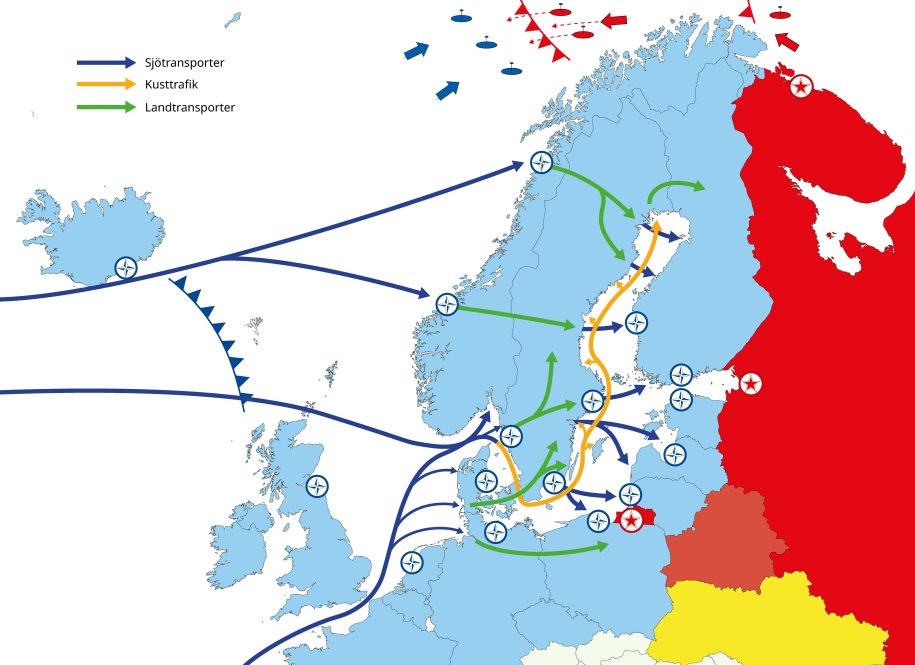
Exempel på omgruppering av Amfibiebataljon 2030 från Amf 4 i Göteborg för att upprätthålla kontrollen över sjövägarna genom Öresund och Bälten. Källa: Försvarsmakten.

Vid defensiva operationer kan Amfibiebataljon 2030 i första hand förutses agera tillsammans med i huvudsak svenska förband, exempelvisbevakningsbåtar och spaningsbåtar. Hela bataljonen kan då användas för att skydda sjövägar och hamnar mot rysk påverkan. Femte amfibiebataljonen löste en sådan uppgift hösten 2023 då hangarfartygetHMS Queen Elizabeth besökte Göteborg. I fråga om skyddet av sjötransporter kan förbandet vara utspritt över en stor yta och uppgiften lösas statiskt under flera veckor. Ett ytterligare exempel på defensiva uppgifter är skyddet av strategiska farledsförträningar. Med sina kvalificerade vapen- och sensorsystem kan amfibiebataljonen i vissa taktiska exempel till och med ersätta ytstridsfartyg i Öresund och Ålands hav.

En kreativ kombination av rörlighet och eldkraft
Utvecklingen av Amfibiebataljon 2030 har från början varit inriktad på högintensiv strid mot en högteknologisk motståndare i närområdet. Erfarenheterna från Ukraina bekräftar att detta har varit det rätta vägvalet.
Den kustnära krigföringens operationsmiljö och ryska förbands förväntade taktik medför att amfibiebataljonerna måste ha förmåga att strida i fyra dimensioner inom ramen för såväl offensiva som defensiva operationer. Ett stort tekniskt framsteg relativt dagens amfibiebataljon är utvecklingen och anskaffningen av tunga verkansystem och sensorer för luft- och sjödomänen.

Nedan följer några exempel på system som kommer vara operativa före nästa försvarsbeslut. Beträffande markdomänen kommer fyra båtar per bataljon att utrustas med 120 mm granatkastare. Den så kallade granatkastarbåten kommer ge amfibiebataljonen avsevärt ökad eldkraft jämte hög  eldberedskap under bataljonens framryckning. Vid strid i efterhand ger granatkastarbåten bataljonschefen avsevärt högre handlingsfrihet än med dagens granatkastare. Eldledning under förflyttning kan göras på olika sätt. En metod som redan är utvecklad är eldledning från vapen- och sensorstationen på Stridsbåt 90 HSM.

Luftdomänen utvecklas både med vapen och sensorer, i första hand för självskydd mot drönare och helikoptrar. Prover är genomförda med två olika 30 mm automatkanoner monterade på en vapen- och sensorstation ombord på Stridsbåt 90. Några av de nyligen beställda Stridsbåt 90 HM kommer även att vara luftvärnsbåtar. Sjödomänen utvecklas både avseende ytstrid och undervattensstrid vilket gör framtidens förband mycket potenta i den tvådimensionella strid mot sjömål som är allra mest effektiv i skärgård och kustnära områden. Den nya Sjömålsrobot 18 kommer vara monteras ombord på några av de nytillverkade Stridsbåt 90 HM. Spaning och eldledning kommer göras med hjälp av X-bandsradar ombord på en eldledningsbåt. Sjömålsrobot 18 kommer ge amfibiebataljonen ett avsevärt större verkansområde än idag. Om sedan Torped 47,  vilken för närvarande utprovas av Försvarets materielverk (FMV), tillförs amfibiebataljonerna kommer marinen på mycket kort tid få en betydligt högre operativ effekt.

Med den ovan beskrivna utvecklingen inom sjödomänen ges Amfibiebataljon 2030 ökade förmåga att lösa såväl offensiva som defensiva uppgifter i strategiskt viktiga farleder som Öresund och Ålands hav.
Med de tre olika systemen – robot 18, torped 47 och X-bandsradar– monterade på olika typer av stridsbåtar kommer amfibiebataljonen att utgöra en viktig komponent i en uppdaterad offensiv ny svensk marin strategi. Framtidens amfibiebataljon kommer att delta aktivt i en operativ kontext där kontroll över sjövägarna ska etableras och kontrolleras.

Från idé till verklighet
Förklaringen till varför utvecklingen av Amfibiebataljon 2030 har varit framgångsrik ligger till stor del i etableringen av en integrerad arbetsmodell med en relativt liten grupp av personer med djup kunskap om amfibiestrid på svenska villkor som deltagare i arbetet. Genom de korta beslutsvägarna har ett tydligt, enkelt och effektivt samarbete mellan amfibiebataljonerna, amfibieregementena, Marinstaben, Sjöstridsskolan, FMV och industrin kunnat etableras. Industrins närvaro har varit högst påtaglig under hela arbetet. Även utländsk industri har deltagit.

Utveckling av Amfibiebataljon 2030 bygger på djupa svenska kunskaper om rörlig strid i skärgård. I Amfibiestudien från december 2017föreslogs ett koncept för taktisk utveckling och ett antal framsynta tekniska
idéer. Under ledning av amfibiestridsenheten på Sjöstridsskolan  och FMV genomfördes sedan under åren 2018–2021 ett stort antal arbeten med kvalitetssäkring av amfibiestudien. Huvudsakliga aktörer var Sjöstridsskolan, Stockholms amfibieregemente, andra och femteamfibiebataljonen samt FMV med konsulter. Arbetsformatet var  Scenariostyrd Verksamhetsanalys (SVA), vilket gav en nära nog perfekt spårbarhet. Resultatet hade sådan kvalitet att Marinstaben och Högkvarteret ledningsstaben och produktionsstaben direkt fattade beslut om både Systemmålsättning 1 och Systemmålsättning 2 för Amfibiebataljon2030. I början av 2022 kunde därför FMV påbörja arbetet med produktdefinition av framtidens amfibiebataljon samtidigt som amfibiestridsenheten  på Sjöstridsskolan fortsatte arbetet med ett antalpraktiska försök avseende teknik och taktik för Amfibiebataljon 2030. Denna arbetsmetod innebar att det gick att hålla högt tempo mot framtiden. Utifrån aktörernas egna yrkeskunskaper byggdes förtroende vilket utvecklade gemensamma kunskaper om amfibieförbandens  taktik och teknik. Och det viktigaste att av allt: det gav möjlighet att fatta beslut snabbt.

En önskan inför framtiden är att anskaffa en tredje amfibiebataljon syftande till bättre uthållighet. Amfibiebataljon 2030 är i det sammanhangeten förbandstyp som relativt snabbt kan skalas upp därför att förbandet är lätt att producera. Förklaringarna till detta är flera. Huvuddelen av materielen finns på marknaden och en avgörande del tillverkas inom landet. Marinen har en stabil utbildningsorganisation för denna typ av krigsförband. Det är därför lätt att rekrytera och behålla personal i krigsförbanden. Sist men inte minst råder det samsyn mellan utvecklare och användare om vad slutmålet är, det vill säga vad Amfibiebataljon 2030 ska utvecklas till.

Avslutande ord
Vilka är då de innersta hemligheterna till framgången med utvecklingen av Amfibiebataljon 2030? Det finns här tre saker som bör framhållas.

  • För det första är personalen på Sjöstridsskolans amfibiestridsenhet skickliga yrkesmän med en genuin vilja att utveckla amfibieförbanden, något som leder till att det framstår som attraktivt att få en kommendering till Sjöstridsskolan eller i samband med övningar samarbeta med skolans amfibiestridsenhet.
  • För det andra finns en kollegial anda byggd på förtroende mellan det begränsade antalet personer som besitter verklig och djup kunskap om svensk amfibiestrid, inte sällan grundad i gemensamma upplevelser på fältet. Det innebär att amfibiekåren, FMV och industrin här  kan mötas kreativt och prestigelöst för att diskutera utvecklingen. Effekten blir att amfibiekårens budskap når fram till olika beslutsfattare i Försvarsstaben, Försvarsdepartementet och FMV.
  • För det tredje drivs utvecklingen av framtidens amfibieförband i  absolut närhet till amfibiebataljonernas kärnverksamhet – strid i skärgård och vid kuster. Studier, taktiska och tekniska diskussioner samt praktiska försök görs med tydliga målsättningar och leds av personer med erkänt höga kunskaper.

Utvecklingen av Amfibiebataljon 2030 är därför på många sätt ett efterföljansvärt exempel när det gäller att snabbt och målmedvetet åstadkomma förmågetillväxt.


TiS 403-409 2025, Utvecklingen av amfbat 2030, F Hesselman

Kungl. Örlogsmannasällskapet – Sveriges maritima akademi vid årets bokmässa

Kungl. Örlogsmannasällskapet deltog tillsammans med andra kungliga akademier vid årets bokmässa i en gemensam monter. De övriga kungliga akademierna i montern var Kungl. Gustav Adolfs Akademien för svensk folkkultur, Kungl. Akademien för de fria konsterna, Kungl. Musikaliska Akademien, Kungl. Skogs- och Lantbruksakademien, och Kungl. Vitterhets Historie-och Antikvitetsakademien. Av de totalt tio kungliga akademierna deltog flera andra i egna montrar.

Kungl. Örlogsmannasällskapet genomförde en rad framträdanden genom Andreas Nilsson, ledamot och akademiens bibliotekarie, ledamöterna Fredrik Hesselman och Patrik Oksanen. De var aktiva under programpunkterna: ”Hybridkrig i marin miljö”, Bibliotekens roll i totalförsvaret”, ”Vad är speciellt med specialbibliotek?”, ”Digitalisering av Kungl. Örlogsmannasällskapets bibliotek” och ”Framtidens svenska marin – en fråga för alla från 1771 och framåt”.

Ledamoten Fredrik Hesselman

Ledamoten Nils-Ove Jansson deltog vid mässan kring sina böcker ”Omöjlig ubåt” och ”Ryska ubåtsoperationer mot Sverige och i Norden”.

Ledamoten Nils-Ove Jansson

­— Jag är mycket nöjd med akademiens genomförande vid Bokmässan. Vi har haft stor och engagerad publik vid våra framträdanden och programpunkter. Ämnena har varit synnerligen aktuella med tanke på omvärldsläget. Jag vill tacka alla som deltog och bidrog till den samlade effekten, säger Andreas Nilsson, sammanhållande för Kungl. Örlogsmannasällskapet vid Bokmässan.


Fotograf: Victor Midenhag


Nya ledamöter i Kungl. Örlogsmannasällskapet

Vid valsammanträdet den 24 september på Sjöhistoriska museet invaldes som ordinarie ledamöter:

  • marinläkare Jan Rutqvist
  • kommendörkapten Magnus Danielsson
  • politiskt sakkunnige Jan Joel Andersson
  • senior fellow Atlantic Council Elisabeth Braw
  • kommendör Marko Petkovic
  • förvaltare Magnus Thylin
  • rektor Henric Johnson
  • studierektor Thomas Frisk.

Till korresponderade ledamöter invaldes professor Henrik Ringbom och politiske rådgivaren  Dr. James Bergeron.

De nya ledamöterna kommer att presenteras vid Kungl. Örlogsmannasällskapets högtidssammanträde i Karlskrona måndagen den 17 november.

Varma gratulationer till alla nyvalda ledamöter. Ni utgör en välkommen förstärkning till Kungl. Örlogsmannasällskapet – Sveriges Maritima Akademi. Vi lever i en tid med stora utmaningar och jag ser fram mot era bidrag och fortsatta gärning inom akademien, säger konteramiral (PA) Odd Werin, ordförande för Kungl. Örlogsmannasällskapet.

Ledamöterna arbetar aktivt utifrån de vetenskapsgrenar som ledamoten fördelas till. Sällskapets vetenskapsgrenar är I Strategi, operationer och taktik, II Personal, utbildning och marinmedicin, III Maritim teknik och IV Sjöfart och andra verksamhetsområden av betydelse för sällskapets verksamhet. 


Kungl. Örlogsmannasällskapet väl representerade vid Donsö Shipping Meet

Den 1 september hölls den största svenska totalförsvarsövningen med fokus på sjöfart i modern tid. Övningen involverade ett stort antal myndigheter och andra aktörer. Infrastruktur- och bostadsminister Andreas Carlson och marinchefen deltog tillsammans med flera talare från KÖMS.
Donsö Shipping Meet samlades privata och offentliga aktörer för att tillsammans öva och utveckla Sveriges totalförsvaret med fokus på att samhällsviktiga transporter alltid ska kunna upprätthållas. Totalförsvarsövningen består av ett antal delövningar där funktioner och aktörer övas i sjöfartens del och ansvar för folkförsörjningen vid högsta beredskap. De privata aktörerna som deltar i planering och genomförande av övningen är bland annat Donsö Shipping Meet, Föreningen Svensk Sjöfart och andra branschorganisationer, rederier, lastägare, hamnar, varv, mäklare och försäkringsbolag.

Kungl. Örlogsmannasällskapet höll tillsammans med Föreningen Svensk Sjöfart ett seminarium under rubriken: Sjöfart & Sjöförsvar – Ledning och skydd av sjöfarten, där ledamoten Mattias Widlund tillsammans med Madeleine Säll från Föreningen Svensk Sjöfart modererade seminariet som täckte en mängd temata inom sjöfart och försvar.

Övningen uppmärksammades också i media: Dagens nyheter skriver om att Sveriges handelsflotta är för liten.

https://www.dn.se/ekonomi/sveriges-handelsflotta-for-liten-maste-dubblas/


Marinchefen Johan Norlén och infrastrukturminister Andreas Carlsson

Utöver infrastrukturministern och marinchefen deltog Kungl. Örlogsmannasällskapet med flera talare:

Kungl. Örlogmannasällskapets ordförande Odd Werin

Ledamoten Niklas Granholm om hoten i närområdet


Ledamoten Mattias Widlund


Ledamoten och VD för Svensk Sjöfart Anders Hermansson


Ledamoten Peter Thomsson


Ledamoten och överdirektören vid Kustbevakningen Henrik Jonsson


Bilder från Albin Dahlin, Sjöfartstidningen


Marina uppgifter och maritim förmåga i Nato

Onsdag den 13 augusti höll Kungl. Örlogsmannasällskapet – Sveriges Maritima Akademi – ett sammanträde i Försvarshögskolans lokaler. Vid mötet talade ordförande Odd Werin, ledamöterna Niklas Granholm och Anders Widén under rubriken: ”Marina uppgifter och maritim förmåga i Nato” med kommentarer från gästande försvarsminister Pål Jonson och tidigare försvarsminister Peter Hultqvist.

Ordföranden med talare och prominenta gäster


Ordinarie ledamoten Anders Widén


Försvarsminister Pål Jonson

Tidigare försvarsministern Peter Hultqvist

”Ledning och skydd av sjöfarten” vid Donsö Shipping Meet 25

Kungl. Örlogsmannasällskapet arrangerar tillsammans med Föreningen Svensk Sjöfart ett seminarium, på temat ”Sjöfart & Sjöförsvar – Skydd och ledning av sjöfarten”, den 1 september 2025 på Donsö inom ramen för Donsö Shipping Meet. Parallellt med seminariet genomförs en större totalförsvarsövning med inriktning säkerställande av sjötransportkapacitet vid högsta beredskap.

För mer information och anmälan, se https://donsoshippingmeet.com/sjofart-sjoforsvar-ledning-och-skydd-av-sjofarten/.

The Sea and Its Strategy


The Sea and Its Strategy final two columns

Foreword

It is with great pleasure that the Royal Swedish Society of Naval Sciences publish this text by Captain (N) RSwN Lars Wedin (ret), also an honorary fellow of the academy. With his deep expertise, strategic perspective, and long experience on defence and security issues, he succeeds in clearly and concisely capturing the essence of the
challenges facing Sweden’s maritime interests and the challenges we face today.

At a time when the world around us is rapidly changing to the worse, with
demands for a quick and stable rearmament, we need reflection, orientation, and decisiveness. This text provides a sharp analysis and easily accessible guidance for the work ahead in connection with the decisions that must be taken at the NATO summit in The Hague. It is our hope that this text will contribute to continued insight and engagement in the debate on our maritime security and the defence of our nation and the alliance.


Royal Swedish Society of Naval Sciences Stockholm, June 15, 2025

  Odd Werin

President


Introduction

This book consists of short summaries of each chapter in the book. The book will be published during the winter 2025–2026 by the Royal Swedish Academy of War Sciences. So, there is still time to make necessary changes or additions. If you, dear reader, have anything you would like to change or add, please write to lars@wedinstrateg.fr

Why do I think it is necessary to write a book with the title The Sea and Its Strategy? One reason is that the Swedish public in general know too little about the navy, shipping, and our dependence of the sea. I devote quite a lot of time and space to the sea itself. Most books on naval strategy do not mention the sea at all, even though it is the object of naval strategy. Admittedly, Jacques-Yves Cousteau’s famous film is called “The Silent World,” but one should not take this film title too literally! Besides, the sea is definitely not silent!

The EU’s explanation why the sea is important is worth quoting, as it provides a kind of justification for the choice of title and subject. The sea is Europe’s lifeline. Europe’s seas and coasts are central to the continent’s well-being and prosperity – they are Europe’s trade routes, climate regulators, sources of food, energy and resources, and popular areas for settlement and recreation.

I would like to take this opportunity to express my gratitude to my academic
fellows at the Royal Swedish Society of Naval Sciences and to Olle Neckman, who created the illustrations.

Combloux, May 31, 2025

Lars Wedin


Preface

Strategically, Sweden is an island. This does not mean that we are isolated – on the contrary, the sea does not divide, it unites as in the old latin words Mare conjugit, non separat. But the sea and its significance are relatively unknown, despite the fact that there are nearly 1 million pleasure boats in Sweden – almost one for every ten Swedes! This book is an attempt to remedy this lack of knowledge.

The book Havet och dess strategi (The Sea and Its Strategy) is intended to be scientific without being too technical. It aims to explain what maritime strategy and naval strategy are and why these concepts are important.

The book is intended for the interested public, but it is my wish that naval officers also will find it useful.

Let’s start by clarifying the difference between maritime and naval. The word maritime encompasses everything related to the sea: sailors, ports, ships, lighthouses…
as well as the sea and its inhabitants: such as fish, mammals and other animals. The word naval encompasses the security and defence-related aspects of the maritime domain, i.e., the Navy, which is part of a nations Armed Forces. From a strategic point of view, the activities of the Coast Guard are also included in the naval strategy.

The starting point is to first explain the connection between the sea and human beings and why this is important. We will then discuss the theory and practice of naval strategy.

In this book, strategy is defined as: Strategy is the science and art of manoeuvring the means of power to achieve political goals. But not just any goals – strategy is about manoeuvring in a situation characterized by (potential) conflict, where two or more states or other actors are manoeuvring to achieve their conflicting goals. Initially, the reader is presented with a reflection on the sea and human history – we will see how humans have learned to utilize the sea – not to master it, because the sea cannot be mastered.

We will then explore why the sea is important to us humans, to us Europeans, and to us Swedes. We will then narrow our perspective and consider the sea as a strategic arena.

Before we dive into the concepts of maritime and naval strategy, we need to familiarize ourselves with the concept of power and how it applies to the sea. From there, we will study these two types of strategy and try to understand how the three concepts of power, maritime strategy, and naval strategy are interrelated.

We then narrow the discussion further and tackle naval strategy, which brings us to peace, crisis, and war. First, we need to understand what characterizes war at sea. Next, we need some theoretical background, so we discuss the great naval thinkers: Mahan, Corbett, and their colleagues, both in the past and present. We will also look at how Swedish naval thinking has evolved over time.

We will then move on to the main section – maritime strategic tasks and the mostly used methods to solve them.

Maritime strategy does not, of course, exist in isolation from the state’s other interests. We therefore need to discuss how it relates to other strategies and policy areas.

We live in a time of rapid development, so what are the actual trends in naval warfare and how do they affect strategy? Hopefully, we now know quite a lot about naval strategy, its means and methods. We conclude this book with a reflection on Sweden as a maritime nation. Then there will be a few more chapters in the book!

Finally, why is all this important? Because the future of mankind, Europe and Sweden in particular lies in and on the sea.

Humans and the sea


Overview and main theme

This chapter deals with humans’ relationship to the sea throughout history, focusing on freedom, trade, conflicts, and culture. The sea is described both as a symbol of freedom and a source of danger, but also as a driving force for development, innovation, and contact through trade between people and cultures.

The freedom of the sea and threats to it

Historically, the sea has been regarded as the common property of mankind, where everyone has the right to travel and trade. This principle, formulated by the Dutch Hugo Grotius in the 15th century, is the basis for today’s United Nation’s law of the sea (UNCLOS). However, freedom at sea is currently threatened by several factors:

  • Territorialisation, where states such as China and Russia are trying to expand their claims to international waters.
  • Expansion of offshore infrastructure, such as wind farms and oil and gasplatforms, which r strict freedom of shipping.
  • Security measures and environmental protection, which lead to new rules and geographical restrictions.
  • Increased demands for protection of the marine environment, including establishment of marine protected areas.

Law of the sea and zoning


A nations internal waters are the area within the so-called baselines, that in principle follows the coastline. Here, the coastal state has full sovereignty.

  • Beyond this lies the territorial sea, which is a maximum of 12 nautical miles (nm) wide. Here, the coastal state has sovereignty. Foreign vessels, including warships, may, however transit through the zone provided they comply with the rules on “innocent passage.” Submarines must transit on the surface.
  • Beyond the territorial sea, the coastal state may establish an contiguous zone where it can practice certain rights regarding migration, historical artefacts etc.
  • The coastal state may also establish an economic zone between the territorial sea and the high seas. This zone extends a maximum of 200 nm, and the coastal state has sovereign rights to explore and exploit the natural resources in the zone.In addition, the coastal state has jurisdiction over the construction and use of artificial islands and “installations and structures,” marine scientific research, and the protection of the marine environment. However, all states have the right to lay pipes and cables, etc. in this economic zone.
  • The continental shelf gives the coastal state rights to the seabed, such as drilling for oil. The shelf normally stretches out to 200 nm from the coastline but can extend further out.
  • The seabed outside the coastal state’s jurisdiction is called the Area and is the common heritage of mankind .
  • 70% of the Earth’s surface is made up of international waters.

The UN Convention on the Law of the Sea states, among other things:

  • The high seas are open to all states, whether they have a coastline or not. Freedom on the high seas is exercised under the conditions set out in the Convention and in other rules of international law.
  • No state may validly subject any part of the high seas to its sovereignty.
  • Every State, whether coastal state or not, has the right to freedom of navigation on the high seas.

The sea as a transport route and engine for development

For thousands of years, the sea has been the most important transport route for people and goods. Shipping has made voyages of discovery and the spread of ideas through trade possible. The importance of shipping for globalisation and economic development has been crucial, from the first voyages some 40,000 years ago to today’s container transport. At the same time, shipping has always been exposed to threats from pirates and conflicts between great powers.

Sweden’s maritime history

Sweden has a long tradition of seafaring and naval warfare. From the large boats of the Bronze Age, through the Vikings’ trading voyages to the east, to the navy and merchant fleet of the Great Power era. During the 16th and 17th centuries, Sweden was a significant maritime and trading power. After 1815, the role of the navy declined and the country adopted a more land-based defence strategy, which continues to have a negative impact on the Swedish strategic culture today.

The roles of the merchant navy and the navy

The merchant navy and the navy have historically been closely linked. A strong navy has protected trade, while shipping has been crucial to the country’s economy and the transport of needed livelihood of the population. During the world wars, the Swedish navy played an important role in protecting shipping and the country’s declared neutrality, but resources were often insufficient.

Culture and identity

The sea has been of great importance in literature, art and mythology. It has always inspired artists, singers and writers and has been a symbol of both hope and danger.
In Swedish culture, however, the sea has often been undervalued, both in historical research and in the strategic debate. The author argues for the need for a new strategic culture in Sweden, where the importance of the sea for the country’s security and prosperity is central.

Conclusion

The chapter concludes that the sea is both a goal and a means in a maritime strategy and that Sweden’s future security and development depends on that the country once again place the sea at the centre of its political and strategic culture. The sea unites rather than isolates, and its freedom must be protected against new and old threats.


Why is the sea important?

The seas are Europe’s lifeblood. Europe’s maritime spaces and its coasts are central to its wellbeing and prosperity – they are Europe’s trade routes, climate regulator, sources of food, energy and resources, and a favoured site for its citizen’s residence and recreation.

An integrated maritime policy for the European Union.

The central role of the sea for Europe and the world

The sea is the fundamental lifeline for Europe and the world. Europe’s seas and coasts are crucial for trade, climate regulation, food and energy supply, as well as recreation and settlement. International shipping drives the global economy, and globalization depends on the sea for the shipping of goods, people, information, and ideas. The sea is a global commons, together with the atmosphere, space, and cyberspace.

Economic and ecological facts about the sea

  • 50% of the oxygen in the atmosphere is produced by the sea (phytoplankton).
  • 60% of the world’s GDP is maritime related.
  • 71% of the Earth’s surface is covered by the sea.
  • 80% of the world’s population lives within 100 km of the sea.
  • 90% of the world’s transport is by sea.
  • 99% of all global information transfer takes place via submarine cables on the bottom of the oceans.

The total economic value of the ocean is enormous, and if the ocean were a country,
its GDP would be the seventh largest in the world.

Geography and dynamics of the ocean

The oceans have a complex and dynamic geography (bathymetry) with varying depths, currents, and ecosystems. Coastal areas are particularly important for human activity, trade, fishing, defence, and environmental protection. International maritime law regulates the nation’s rights to resources and exploitation of the continental shelf and economic zones.


The seabed and its resources

The seabed is rich in resources such as oil, gas, sand, minerals, and metals. However, extraction is costly and involves high environmental risks. Infrastructure such as pipelines, power cables, and fibre optic cables are strategically important and vulnerable to sabotage and accidents, as recently highlighted through several incidents in the Baltic Sea.

Environmental challenges and climate change

The oceans are threatened by pollution, overfishing, and climate change. Eutrophication, plastic waste, and emissions have a strong negative impact on ecosystems. The oceans absorb a large proportion of greenhouse gasses and heat, which leads to acidification, dying coral reefs and affects biodiversity and diminishing fish stocks.

Global warming is also causing sea levels to rise and extreme weather events to become more frequent.

Fishing and its challenges

Fish is an important source of protein globally, but overfishing and illegal fishing are major problems. Many fish stocks are overexploited and some have collapsed completely. Fishing is also a potential source of international conflict.

Maritime industries and the blue economy

The EU’s blue economy encompasses established sectors such as fishing, shipping, ports, shipbuilding, and coastal tourism, as well as emerging sectors such as blue biotechnology and marine energy.

Maritime industries are important for growth and employment and must be developed sustainably so as not to harm the environment.

The strategic importance of shipping

Shipping is crucial to the global economy and Sweden’s livelihood. Most Sweden’s import and export products are transported by sea. However, the Swedish merchant fleet has declined, which increases vulnerability in times of crisis or conflict. Shipping is also dependent on functioning ports and infrastructure.

Security and threats to the sea

The sea is an arena for conflict, hybrid warfare, piracy, and terrorism. Protecting critical infrastructure, such as cables and pipelines, is a growing challenge. Cooperation between civilian and military actors is needed to address these threats and to ensure freedom of movement and safety at sea.

Environmental protection and international goals

The UN’s Sustainable Development Goal 14 aims to conserve and sustainably use the oceans. This includes reducing pollution, protecting ecosystems, promoting sustainable fishing, and strengthening research and technology that contribute to healthier oceans. The EU and Sweden are working on strategies to protect marine environments and species, but the challenges are great and require international cooperation.

Conclusion

The ocean is crucial to mankind’s survival, economy, and environment. Its resources and ecosystems must be managed sustainably to ensure future prosperity and security. Sweden’s and Europe’s future is strongly linked to the health and safety of the ocean, which requires coordinated efforts at the national and international levels.


Power and Strategy


Sea power did not win the war itself, but it made it possible to win the war.

Admiral Sir Herbert Richmond.

When you master the sea, you master everything.

Marcus Tullius Cicero (106 – 43 BC), Roman statesman.


Power and strategy

  • Power is defined as the ability and willingness to change or exploit a situation to achieve a political goal. Power can be offensive (by influencing others) or defensive (protecting oneself from influence from other actors).
  • Power is not only about resources but also about legitimacy, credibility and cultural influence.
  • Effective power requires that resources can be mobilized and used strategically, and that the political project is supported by the population.

The nature of strategy

  • Strategy is the science and art of using power to achieve political goals. It links action to effect and instruments to the desirable goals.
  • Strategy is formed in a dialectical relationship between actors with conflicting wills, where each party adapts its strategy to the actions of its counterpart.
  • Strategy is both a science (theories, historical lessons identified and learned) and an art (creativity, adaptation to uncertainty and friction).

Strategic levels

  • Grand strategy (overall strategy) is broken down into military-strategic, operational, and tactical levels, each with its own goals and means to achieve the goals.
  • There is no strict boundary between the levels; actions at the tactical level can have strategic and political consequences.

Manoeuvre and freedom of action

  • Manoeuvre is the active part of strategy and aims to create advantageous situations through will, power and freedom of action.
  • Freedom of action and economic utilization of resources are cetral concepts. Spreading resources too thinly leads to fragmentation of power and loss.

Offensive, defensive, direct and indirect

  • Strategic manoeuvres can be offensive (changing to one’s own advantage) or defensive (maintaining an advantageous situation), as well as direct or indirect.
  • At sea, the offensive is often stronger than the defensive, unlike on land

Means of power and goals

  • Different means of power (military, economic, diplomatic) are combined to achieve political goals. It is the strategist’s task to choose the right combination and path.
  • The political goal is paramount, and the strategy should lead to its achievement, but it is often difficult to translate military success into political success.

Seapower and maritime strategy

  • Sea power is the ability to influence situations in the maritime domain to support political goals, and consists of the navy, merchant fleet, marine industries, etc.
  • Maritime strategy is about using maritime means of power to contribute to the nation’s political and economic goals, including prosperity, resource utilization, and security.
  • Naval strategy is a subset of maritime strategy and focuses on military aspects, such as maintaining a good order and security at sea.

Swedish and international context

  • Sweden has historically had periods of strong naval power but has hardly been
    a Thalassocracy (a maritime power in the cultural and political sense).
  • An effective maritime strategy requires coordination between civil and military actors, as well as support from other policy areas (economy, education, diplomacy).
  • International cooperation, particularly within the EU, is crucial for addressing common maritime challenges.

Conclusion

  • Strategy is both a science and an art, and must always take into account changing circumstances, legitimacy and international norms.
  • Sea power and maritime strategy are crucial to national security, prosperity, and the ability to influence international relations.


The Nature of Naval Warfare

It was an inhuman situation; [low ammunition, relatively slow speed due to damaged ships after four days of fighting enemy aircraft] but I have always believed that if the enemy is in sight at sea, air attacks or other considerations must be disregarded and the risks accepted.

Admiral AB Cunningham.

What could be more terrible than a battle at sea, where both fire and water unite to
destroy the combatants?

Vegetius (5th century AD).

Double challenge – the sea and the enemy

The naval sailor always faces two opponents: the sea, which is unpredictable and can never be tamed, and the human enemy. This duality characterizes all naval operations and justifies the need for a specific naval strategy, in addition to a common service strategy.


The Navy’s role in peace and war

The Navy and Coast Guard have important tasks even in peacetime, such as maintaining good order and security in Swedish waters and show presence. The transition time from peace to war is short – a few minutes. Each ship is an independent tactical unit, and the skill and initiative of the crew are crucial for survival and success.

Characteristics of naval forces

  • Ships are expensive and take a long time to build, the same as it does to train the crews.
  • They often operate far away from senior command, which requires initiative and independence.
  • Orders are often sent from senior command by technical means such as satellite or radio communication.
  • Cooperation with other domains (land, air, cyber, etc.) is required.
  • Naval forces have great endurance and mobility, but distances at sea are even greater.
  • They are dynamic and can quickly switch between combat, humanitarian
    operations, and other roles.

Basic elements of combat

Naval warfare rests on three pillars: intelligence/surveillance/reconnaissance (ISR), firepower, and command and control. These interact to search for and defeat the enemy and protect friendly forces.The OODA loop (Observe, Orient, Decide, Act) is used to describe the decision-making process in combat.

Weapon systems and forms of combat

  • Air defence: Modern ships have advanced anti-air defence missiles and can act as floating command centres for air warfare (AW). New technologies such as micro-wave and laser systems are being tested to counter new threats such as drones.
  • Naval targets: Anti-ship missiles are the dominant long range stand-off weapon system, but artillery and torpedoes are also used. Railguns and kamikaze drones are under development or in use.
  • Submarine warfare: Submarines are characterized by their ability to remain hidden and surprisingly attack their enemies. They have advanced sensor systems and can carry both torpedoes
    and anti ship and ballistic missiles.
  • Anti-Submarine warfare (actively search
    for and destroy a submarine) is very
    difficult and requires timely cooperation between ships, aircraft and helicopters, and sensors.
  • Mine warfare: Mines are used both offensively and defensively and have become increasingly sophisticated.
  • Mine clearance is nowdays often carried out by using a combination of manned and unmanned systems. Mine clearance takes long time, and full safety can never be achieved. Shipping in mine infested waters remains risky.

Combat against land targets and amphibious warfare

Ships can attack land targets with artillery and long-range missiles, and amphibious units can operate in the border zone between sea and land, especially important in archipelagos. These units must be able to utilize both the sea and land to their advantage in order to control important areas and routes of communications.

Command and coordination

Effective command and control of naval forces are crucial. Tactical commanders must be able to take correct and quick decisions under uncertain conditions and adapt to changing conditions. The balance between central control of naval forces and the freedom for the tactical commander is important to create and to encourage initiative and flexibility in combat.

Special features of naval warfare

  • Naval warfare is characterized by:
  • Speed and destruction in combat
  • Short, intense combat phases within prolonged operations, sometimes over years
  • Uncertain condition and the need to encourage initiative
  • Differs greatly from land warfare, in special in mobility, intelligence collection, and vulnerability

Historical examples and lessons

Examples from the Falklands War, World War II, and the Cold War submarine intrusion and violations in Swedish waters illustrate how quickly war at sea can develop and how difficult it is to protect naval units against surprise attacks. Experience shows that the threat from the sea is constant and that technology, training, and tactics must constantly evolve and be developed as new technology is introduced.

Conclusion

Naval warfare requires special capabilities, technical systems, and understanding leadership. It is unpredictable, risky, and places high demands on both people and equipment. To understand and meet these challenges requires a deep understanding of the nature of naval warfare, technical expertise, and a constant adaptation to new threats and opportunities.


Naval strategic culture

The picture depicts Commander Daniel Landquist 1891 – 1972;
Sweden’s most prominent naval strategist.


La stratégie ne reste pas immobile… elle évolue légèrement. C’est, pour employer un terme désuet, une ‘variable amortie’. Mais elle se développe néanmoins. Il serait une erreur de s’en remettre à son immuabilité

Strategy does not remain motionless… it evolves slightly. It is, to use an old?fashioned term, a ‘dampened variable’. But it develops nonetheless. It would be a mistake to rely on its immutability. Amiral Raoul Castex, Théories Stratégiques, 1929–1935

Strategic culture and its significance

A strategic culture is about a country’s unique way of thinking about war and strategy, shaped by its historical experiences, technical resources, and geopolitical conditions. The Swedish naval strategic culture has been influenced by both national and international ideas and has often differed from other countries in its defensive orientation and emphasis on defending the country against an amphibious invasion from the sea rather than promoting own trade or offensive interests at sea.

International influences and theoretical schools

Swedish naval thinking has been inspired by foreign strategists such as Colomb, Mahan, Corbett, and Castex, as well as by French, British, and American doctrines. Various schools of thought are presented, such as the classical (focus on victory), neoclassical (broader sociological perspective), modern (social science view), and postmodern (criticism of linear relationships). The geopolitical, material, and scientific-rational methods are also discussed.

The development of Swedish naval strategy

  • Since the end of the 19th century, Sweden’s naval strategy has been developed by several important thinkers and reformers:
  • Anton Baeckström emphasized archipelago warfare and coastal defence, with
    a focus on the utilization of equipment and tactical lessons learned from
    contemporary wars.
  • Carl-Gustaf Flach introduced the concept of “Fleet-in-being” in Sweden, which means that even inferior naval forces can pose a deterrent threat by avoiding combat and striking at the right moment.
  • Daniel Landquist emphasized the importance of contesting the enemy’s naval supremacy and advocated a combination of defensive strategy and offensive tactics.
  • Stig H:son-Ericson renewed the navy with Naval Plan 1960 (Marinplan 60), which focused on smaller, more manoeuvrable and agile naval ships and emphasized a deepened cooperation between the branches of the armed
  • Claes Tornberg and Christer Hägg contributed to an intellectual revival of strategic thinking in the 1980s, with a focus on initiative, surprise, and operational mobility.
  • Per Edling and Fredrik Hesselman have, in connection to Sweden’s NATO membership (2024), argued for a more offensive doctrine with a focus on maritime control and international cooperation.

Main lines of Swedish naval strategic development

  • From the beginning of the 19th century, the main task of the navy was to defend the country from an amphibious invasion from the sea, control the archipelago and oddly support the army’s retreat along the large lakes towards Lake Vättern, where the final battle would take place in front of Karlsborg Fortress.
  • During the 20th century, the strategy shifted between defensive and offensive approaches, depending on the geopolitical threat scenario and technological developments.
  • During the world wars, protecting shipping became central, but after the wars, the focus returned to anti amphibious invasion from the sea. The experiences from the wars where quickly forgotten.
  • The Cold War was characterized by a defensive strategy, supporting and cooperation with the army, while protection of shipping was deprioritised.
  • In recent years, the need for maritime control and international cooperation has once again become central, especially after Sweden’s accession to NATO.

The role of education and debate

Education at both Swedish and foreign naval academies has been crucial to the development of Swedish naval strategic culture. A free and broad intellectual debate has been important in renewing and adapting the strategy to new geopolitical conditions.

Conclusion

Sweden’s naval strategic culture has been shaped by both domestic and international ideas and has been characterized by a shift between defensive and offensive strategies depending on the geopolitical situation. From being focused on protecting the coast and contesting enemy control, the strategy is now moving towards maintaining maritime control and participating in international operations together with allies and partners.


The Maritime Strategic Toolbox

Opportunity comes like a snail and disappears like lightning. Captain (N) RSwN Göran Frisk, commanding the anti-submarine warfare unit in the 1980s.

Hit first. Hit hard. Keep on hitting. Admiral of the Fleet, Sir John Arbuthnot “Jackie” Fisher, Royal Navy.

Angriff, angriff, angriff. Admiral Karl Dönitz


Strategic Theory and Doctrine

  • Strategic theory is about understanding and formulating the basic principles for how naval power can be used to achieve political goals. Theory provides insights and guidance but gives no exact answers.
  • Doctrine is the practical application of theory – official guidelines for how naval operations should be conducted. Good doctrine is based on theory, experience, and adaptation to one’s own capabilities and those of the adversary.

The objectives of naval strategy: Sea Control and Sea Denial

  • The main objective of naval warfare is to use the sea for one’s own purposes
    (Sea Control) and/or to deny the adversary this opportunity (Sea Denial).
  • Sea Control means securing control over maritime communications to protect one’s own shipping and to enable offensive operations against the enemy posing
    a threat to one’s own shipping.
  • Sea Denial aims oneself to prevent the enemy from using the sea, without
    necessarily having all the means to create full control. This can be achieved with fewer resources, e.g. through mines, drones or coastal missiles.
  • Both Sea Control and Sea Denial are always local, temporary, and limited – total control is impossible.

Strategic methods

  • Strategies can be sequential (step-by-step) or parallel (simultaneous), cumulative (many small efforts that together achieve the desired effect), or paralyzing (manoeuvre warfare to quickly knock out the enemy’s ability).
  • Historical examples illustrate different strategic choices, such as decisive battles (which are rare), blockades, raids, and war of attrition.

Strategic tasks and naval functions

  • Naval strategy means that a nation is being able to: gather intelligence, prevent threats, deter enemies, protect one’s own interests, intervene when necessary, and project power against land.
  • Other important tasks include naval presence, blockade, defence/attack agai
    nst sea communications, naval diplomacy, maritime security, and humanitarian operations..
  • The protection of sea lines of communication and critical infrastructure, as well as intelligence gathering and surveillance capabilities, are also central in peacetime.
  • Leadership and lessons from history
  • Successful naval strategy requires strong leadership, an offensive spirit, flexibility, good intelligence and the ability to create surprise.
  • Historical naval battles show the importance of decentralized command, coordination, endurance and the ability to adapt quickly to changing conditions.

Contemporary challenges and hybrid warfare

  • Modern naval strategies must also address new threats such as hybrid warfare, where attacks on infrastructure, information warfare, and legal gray zone areas are central
  • Maritime security today also includes protection against terrorism, piracy, environmental threats, and cyberattacks

Conclusion

Maritime strategy is an interdisciplinary discipline that combines theory, doctrine, historical experience, and practical application. It is crucial for protecting national interests at sea, contributing to international security, and dealing with both traditional and new maritime threats.


Dimensions, domains and interdependencies

More than other strategies, military or otherwise, naval strategy is rarely free. It may have freedom of action in the technical execution of certain operations, but very often it does not have it in the choice of these operations. Admiral Castex.

Dimensions

  • Maritime strategy plays out in several physical dimensions: length, width, height (space above and below the surface) and time, which is crucial for movement and decision-making.
    Naval forces operate on, above and below the sea surface and on the seabed,
    where critical infrastructure such as cables and pipelines are also located.
  • Deep sea operations are becoming increasingly important, particularly in terms
    of protecting and monitoring infrastructure at great depths.

Domains

  • Naval warfare is conducted in multiple domains: land, sea, air, space, cyber, electromagnetic, and cognitive.
  • Each domain has unique characteristics and challenges, and an effective strategy requires coordination across multiple domains (Multi-Domain Operations, MDO).
  • In addition to the traditional domains, the electromagnetic and cognitive domains are particularly important in modern naval warfare.

Special domains

  • The space domain has gained increased military and civilian importance, including being used for communications, navigation, and surveillance. Commercial actors are playing an increasingly important role supporting these technical systems.
  • Cyberspace is a virtual domain where information systems, networks, and digital operations take place. Cyber warfare is used for espionage, sabotage, and influence.
  • The electromagnetic domain encompasses all use of radio signals, radar, and directed energy, and is central to both intelligence and combat.
  • The cognitive domain involves influencing people’s thinking, decision-making, and moral, for example through propaganda, disinformation, and psychological operations.

Mutual dependencies (servitudes)

  • Naval strategy is dependent on other strategies, such as industrial, economic, diplomatic, and legal strategy, and vice versa.
  • Example: The navy needs an industrial capacity for its equipment, while the economy is dependent on open sea lines of communication for import and export of goods and commodities.
  • Legal and political frameworks, such as international law, national regulations, and Rules of Engagement(ROE), regulate what military commanders can do.
  • Multi-Domain Operations (MDO). Modern operations require coordination between the land, sea, air, space, cyber, electromagnetic, and cognitive domains.
  • Prioritization problems and resource allocation between the different domains
    are as always, a key challenge, but this is nothing new.
  • Historical and contemporary examples show that successful leadership requires flexibility, an holistic view, and the ability to take initiative quickly.
  • MDO makes for attractive PowerPoint presentation slides but is not new in itsel
  • As early as 1900, the then Commander Herman Wrangel wrote that the branches of the armed forces are dependent on each other: It is precisely the constant flow of communication across the sea that can most easily be disrupted, even by a few warships. Herein lies the most important strategic link between a defending army and navy. The larger and more powerful the army are, the easier it is for the navy to fulfil its most important role, as long as it has freedom of action.

Conclusion

Maritime strategy must be seen as an integral part of a larger system in which several domains and dimensions interact and where mutual dependencies – between military, civil, technical, and legal factors – are crucial for success. An effective strategy requires both specialization within each domain and the ability to coordinate and see the big picture.


Humans and Technology in Naval Warfare

Ex Scientia Tridens – From Knowledge, Sea Power. Motto of the US Naval Academy.

The maintenance of ground combat units in Western Sahara during World War II took a continuous toll on the British small ships). “They were patched together time and again and needed extensive repairs, and could only be kept operational thanks to the enormous will and determination of the officers and crews in the engine rooms.
Admiral AB Cunningham.


Technology, Innovtion and Adaptation

Naval warfare is a human phenomenon in which the sea is the object, man is the subject, and technology is the means. For a navy to be successful, it requires both technical knowledge and the ability to innovate and adapt. Innovation is necessary in both peace and war but must be balanced against the risk of technological dead ends. Experience from the war in Ukraine shows the importance of rapid innovation and civil-military cooperation, while Swedish procurement have often been hampered by time consuming bureaucracy.

Resource strategy and oprational strategy

Resource strategy aims to provide the operational strategy with the necessary resources – people and equipment. There is a mutual dependency between resource and operational strategy, where long lead times and misjudgements can have major consequences. A fleet cannot be improvised; it takes long time to effectively organize a navy to recruit and train personnel and to procure the equipment.

The importance and limitations of technology

Technological advances and innovations have always influenced naval warfare, but technology must be robust, durable, and reliable to function in the harsh environment at sea. The number of ships and their crews is crucial for endurance and flexibility – quality and quantity must be balanced. “Silver bullet” solutions are rarely successful in the long run.

Nuclear weapons and naval aspects

This chapter discusses the role of nuclear weapons at sea, particularly continuous at sea deterrence and second-strike capabilities with strategic submarines. Nuclear weapons at sea are seen as more flexible and less escalatory than on land, but they pose major strategic and ethical challenges. For Sweden, the most important defence measure is to build general resilience and protect critical infrastructure rather than acquire its own nuclear weapons.

Artificial intelligence (AI) and drones

AI is becoming increasingly important for naval strategy and tactics, particularly for decision making support, surveillance, and command and control. AI can quickly absorb and handle large amounts of data and facilitate decision-making, but it is dependent on access to data, robust algorithms, and human control.

Drones (UAVs, USVs, UUVs) are developing rapidly and becoming increasingly important for reconnaissance, mine clearance, logistics, and offensive operations, but cannot yet completely replace manned vessels. However, they are an increasingly important complement.

People in the centre

Despite technological advances, people and their will, training, leadership, and morale are crucial to success. Fatigue, lack of training, and poor organization can lead to accidents and defeat. Diversity, equality, and inclusion contribute to a stronger and more flexible defence forces but require the right selection and training.

Leadership and strategy

Effective leadership requires both good seamanship, technical and tactical competence and the ability to build trust and morale. Studies of strategy and historical examples show that adaptability, initiative, and decentralized leadership are crucial, especially in the chaos of war.

Conclusion

Technology and innovation are necessary, but must always be combined with human competence, will, and leadership. Naval warfare is won by those who can best combine seamanship, technology, adaptability, strategy, and human resources – and who understand that war is ultimately a battle of wills.


Sweden – a maritime nation!

Look at a map of the Nordic region. What do we see? A large landmass with a hole in the middle. This hole is filled with water and is called the Baltic Sea. At the bottom left of the picture is an opening – an opening to the great oceans.

But you can also look at a map on a larger scale. Then the Nordic region appears with the Baltic Sea as a spit of land sticking out from the dominant Eurasian landmass. You can see that there is much to support Spykman’s geopolitical theory of the Rimland.This has nothing to do with poetry but means the edge of the land: the area that separates the Heartland – Russia and Central Asia – from the great oceans and the new world.

This location also explains our history.
We have been torn between sea power and land power. While the Swedish Vikings followed the rivers into the heartland in the east, Danish and Norwegian Vikings explored the great oceans and Europe’s borders with them.

Medieval trade was controlled by the Hanseatic League. There is a reason why Stockholm’s largest church is German: St Gertruds. And why Stockholm’s bourgeoisie was ruled by Germans. When Sweden gained independence from Denmark in 1521, it was thanks to the fleet that Gustav Vasa had purchased from Hansa City of Lübeck in today’s Northern Germany. During the 15th and 16th centuries, the Swedish Empire expanded along the shores of the Baltic Sea from Finland, via the Baltic States and northern Poland and Germany. It was the fleet that held Sweden and its Baltic provinces together and enabled Sweden to become a maritime and regional superpower. But the Danes that sat on the Baltic approaches was the main naval competitor and they did what they could to hamper the Swedish trade.

Initially, the merchant fleet played a minor role. Unlike most other European maritime powers, Sweden’s fleet was focused on power projection rather than maritime protection. However, the Swedish merchant fleet became increasingly important, and Stockholm was a major maritime city until the early 19th century.

In the 1670s, 28 large merchant ships were registered in Stockholm. This dominance was reinforced by the Botnia trade monopoly, which required all trade with Norrland and Finland to sail via Stockholm. During the 18th century, Stockholm’s merchant fleet underwent experienced explosive growth, and by 1800 there were 685 registered merchant ships, corresponding to 40% of the entire kingdom’s merchant fleet.

After the Napoleonic Wars, the Swedish merchant fleet grew steadily, and by 1830 it was larger than it had ever been during the commercially vibrant 16th century. This positive development continued throughout the 19th century, with a decline in the early 1890s in connection with the transition to steam and iron ships. However, by the end of the 1890s, there was a new upturn linked to the growth of the Swedish engineering industry.

Here too, the merchant and naval fleets were out of step. While the merchant fleet grew, the naval fleet virtually disappeared as the main task of the navy was to defend the country from an amphibious invasion from the sea in 1819.

The world wars emphatically demonstrated how important the two fleets were to defend Sweden’s livelihood. These lessons were immediately forgotten after the second world war – and effectively counteracted. Both fleets had a heyday after the Second World War. Sweden had one of the world’s largest merchant fleets and the navy had over a hundred warships – although not all of them were modern. We also had a prominent shipbuilding industry.

But from the 1970s, there was a double decline: the shipyards disappeared as the industry could not any longer compete on the market, the merchant fleet was flagged out due to high cost for salaries, and many of the bigger warships were scrapped. The period after 2004 was particularly critical, and it will take a long time before we once again have a navy worthy of the name. The decision to equip the Visby corvettes with anti-air defence missiles is extremely positive, but about fifteen years too late!

Our country’s accession to NATO means that the Swedish Navy now has new heavy responsibilities: to keep the sea lines from the Atlantic Ocean to the ports of the Baltic Sea open. This will require a lot more resources in ships and personnel. However, the navy and merchant fleet still play a minor role in the Swedish debate as long as the sea blindness continuous to prevail in our country.

As far as maritime industries are concerned, the need for better economic conditions, such as tax breaks, is well known; the Swedish maritime industry must be internationally competitive.

There needs to be a collective and accepted awareness that shipping, maritime security, and defence are strongly interlinked

Five pillars for maritime ambitions

  1. Cultural: Build a collective maritime awareness. This means integrating maritime history, geography, and culture into school curriculum, promoting public interest, and marketing maritime professions.
  2. Maritime: Maintaining a capable and technologically advanced navy is crucial for sovereignty, crisis management, and participation in international security.
  3. Diplomatic: Sweden as a strong trading nation must influence global maritime governance and balance national interests with collective international responsibilities.
  4. Economic and technical: Investing in the “blue economy” through innovation, investment, and sustainable practices is crucial for competitiveness and sovereignty.
  5. Scientific: Invest in oceanographic research to understand and manage marine resources, climate change, and biodiversity.

Strategic challenges and
recommendations

These maritime ambitions require that several obstacles are overcome such as:

  • Too fragmented governance: Maritime policy is spread across several ministries.
    Too fragmented maritime expertise: The fragmented political governance is matched by fragmented knowledge among those working in the maritime world. At the WMU (World Maritime University; run by the UN) in Malmö, Sweden has access to world-unique maritime expertise. But few Swedes study there – and even fewer become naval officers!
  • The perception of the Public: There is a serious lack of maritime awareness among both among the general public and decision-makers.
  • Industrial needs and labour requirements: The maritime sector faces a shortage of skills and a need to attract young talent, particularly in technical and scientific fields.
  • Sustainable development: It is crucial to find a balance between the exploitation of marine resources and the protection of the environment.

Conclusion

Sweden must overcome cultural, structural, and strategic inertia a create a momentum for maritime development. Achieving this will require a long-term, integrated maritime strategy that encompasses culture, defence, diplomacy, economics, food and livelihood security and science, anchored in a renewed national and European ambition for the sea.